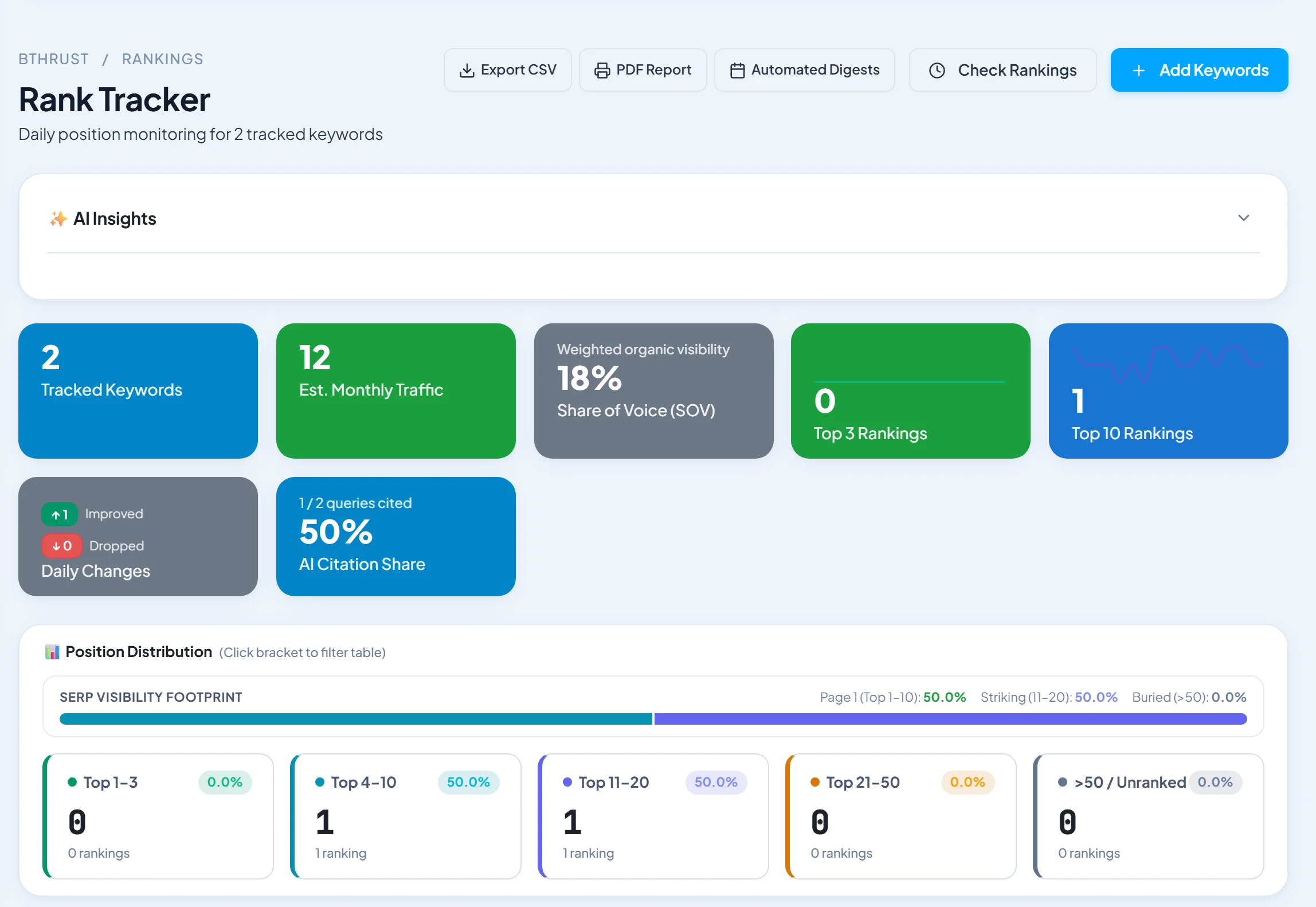
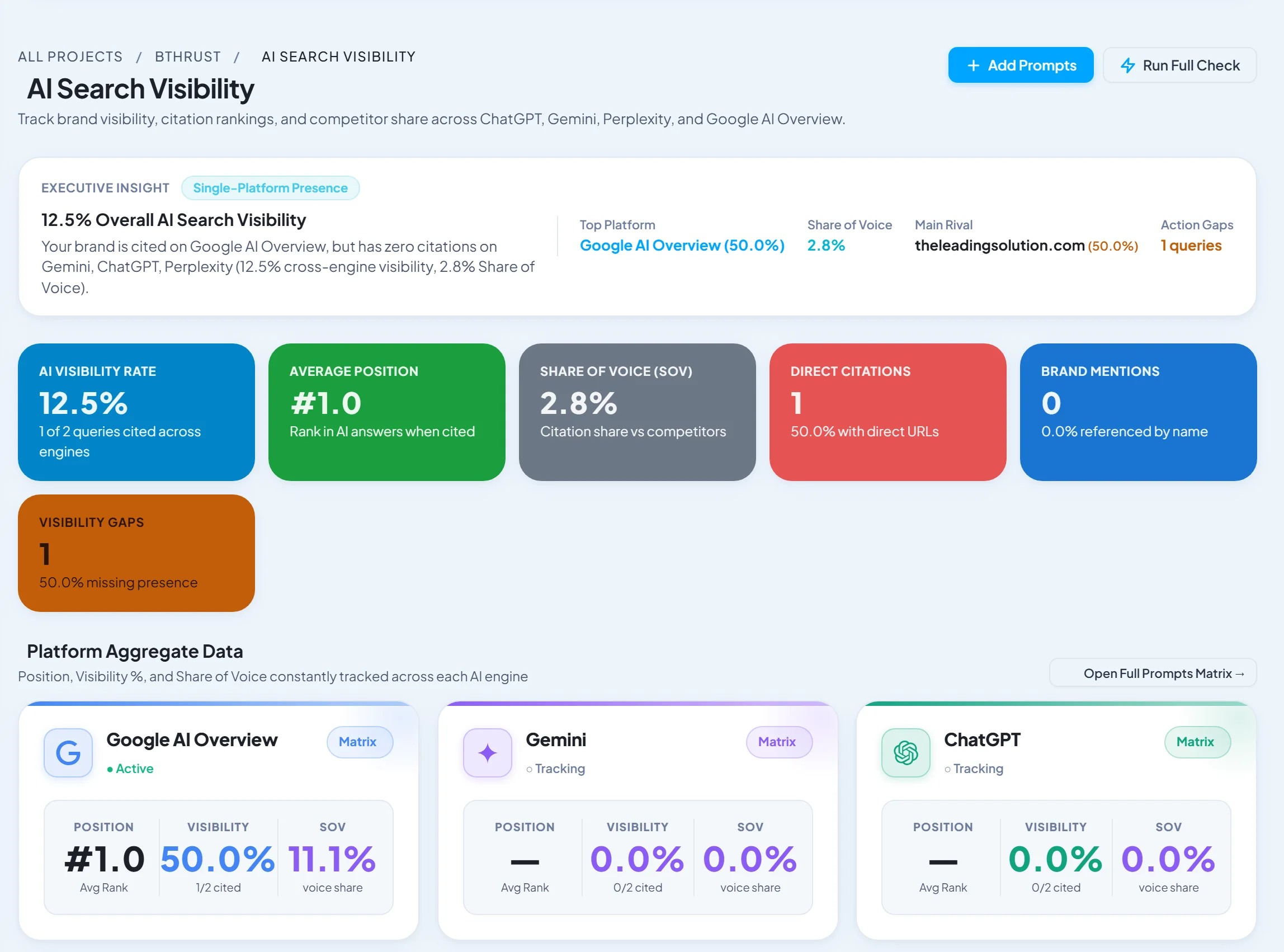
Short answer: SEO Runway is the best GEO tool for most teams. It audits your site for AI readiness, ranks the fixes, and tracks whether ChatGPT, Gemini, Perplexity and Google AI Overviews start mentioning you. Semrush AI Toolkit is the natural choice for Semrush users, and Profound leads for enterprise brands. Generative engine optimization (GEO) means improving your content and site so AI engines mention and cite you. The tools below help you do that work, not just watch the results.
Disclosure: SEO Runway is our product. We used the same criteria for every tool and point out where others are stronger.
Quick picks
- Best overall (audit + fixes + tracking): SEO Runway
- Best for Semrush users: Semrush AI Toolkit
- Best for enterprise: Profound
- Best for content teams: Writesonic GEO or Surfer
- Best budget audit: Otterly.AI
GEO tools compared
| Tool | AI-readiness audit | llms.txt check | Citability recommendations | AI answer tracking | From |
|---|---|---|---|---|---|
| SEO Runway | Yes, with prioritised fixes | Yes | Yes | Yes (AI Overviews, ChatGPT, Gemini, Perplexity) | $29 |
| Semrush AI Toolkit | Partial (with Site Audit) | Check | Yes | Yes | ~$99 add-on* |
| Profound | Yes | Check | Yes, deep | Yes | Sales-led* |
| AthenaHQ | Yes | Check | Yes | Yes | See site* |
| Goodie AI | Yes | Check | Yes | Yes | See site* |
| Writesonic GEO | Partial | Check | Yes, content-led | Yes | See site* |
| Otterly.AI | Yes (GEO audit) | Check | Partial | Yes | ~$29* |
| Scrunch AI | Yes | Check | Yes | Yes | See site* |
| Surfer (AI Tracker) | Content-level | No | Yes, content-led | Yes | Add-on* |
| Search Atlas | Partial | Check | Yes | Partial | See site* |
*Approximate or unpublished. "Check" means we could not confirm the feature from public documentation.
How we chose these tools
We included tools that help you improve AI visibility, not only measure it. We compared published features, plans and documentation against six criteria:
- AI-crawler access checks: does the tool tell you if GPTBot, Google-Extended, PerplexityBot and others can reach your pages?
- llms.txt support: checks or guidance for the emerging llms.txt file.
- Citability recommendations: advice on structure, direct answers and facts AI can quote.
- Schema and entity guidance: structured data and consistent brand facts.
- Prioritised fixes: a ranked list, not a wall of warnings.
- Tracking to prove impact: a way to see whether AI answers change after the fixes.
1. SEO Runway: best GEO tool overall
Verdict: covers the full GEO loop in one place: audit the site, fix in priority order, then track prompts across four AI engines to see the effect, all beside your classic SEO data.
Best for: agencies and in-house teams who want GEO work and SEO work in the same project.
Key GEO features:
- An AI-readiness audit covering AI-crawler access in robots.txt, llms.txt, and whether key pages contain content AI can cite.
- Prioritised fixes, ranked by impact.
- Prompt tracking across Google AI Overviews, ChatGPT, Gemini and Perplexity (by plan), with mention and citation detection.
- The competitors and sources AI cites instead of you, so you know which pages to improve.
- The site audit, rank tracking and white-label reports in the same project.
Pricing: AI GEO plans from $29/month; SEO + AI bundles from $129/month; 14-day free trial. See plans.
Pros: audit, fixes and measurement in one loop; classic SEO context alongside.
Cons: tracks four AI engines, while Profound covers more; a newer brand with fewer third-party reviews than the incumbents.
2. Semrush AI Toolkit: best for Semrush users
Verdict: adds AI visibility and perception insights to Semrush, where Site Audit and content tools already cover much of the technical groundwork.
Key features: brand perception and visibility in AI answers; competitor comparison; content and question insights; it works alongside Semrush Site Audit.
Pricing: a paid add-on (around $99/month, verify) on top of a Semrush plan.
Pros: deep data ecosystem; familiar interface.
Cons: the total cost is high; GEO-specific checks are spread across several tools.
3. Profound: best for enterprise GEO
Verdict: the most complete enterprise option for understanding, and then shifting, how AI engines talk about a brand.
Key features: wide engine coverage; analysis of which content AI draws on; prompt-volume research; optimisation insights.
Pricing: sales-led.
Pros: depth and scale.
Cons: enterprise budgets only.
4. AthenaHQ: best for action plans
Verdict: leans into recommendations, telling you what to publish or change to be recommended more often.
Key features: visibility tracking; competitor gaps; content recommendations.
Pricing: see AthenaHQ's site.
Pros: action-first.
Cons: aimed at funded growth teams.
5. Goodie AI: best GEO specialist for brands
Verdict: a dedicated AI search optimisation platform combining monitoring, audits and optimisation guidance.
Key features: AI visibility monitoring; site and content audits for AI; recommendations.
Pricing: see Goodie's site.
Pros: GEO-focused from the ground up.
Cons: no classic SEO toolkit beside it.
6. Writesonic GEO: best for content production
Verdict: combines AI visibility insights with a content engine, which suits teams that need to publish citable content quickly.
Key features: AI visibility tracking; content gap insights; AI writing tied to those gaps.
Pricing: see Writesonic's site.
Pros: goes from insight to draft quickly.
Cons: technical GEO checks are lighter.
7. Otterly.AI: best budget GEO audit
Verdict: an affordable starting point that combines prompt monitoring with a GEO audit.
Key features: brand and link monitoring; a GEO audit; simple reports.
Pricing: from around $29/month (verify).
Pros: low cost.
Cons: less depth in recommendations.
8. Scrunch AI: best for brand positioning
Verdict: strong on how AI describes your brand and where those descriptions come from.
Key features: positioning monitoring; source insights; optimisation guidance.
Pricing: see Scrunch's site.
Pros: a perception focus.
Cons: premium pricing.
9. Surfer (AI Tracker): best for on-page content teams
Verdict: best known for content optimisation; its AI tracking adds a GEO view for writers already using Surfer.
Key features: content scoring; AI visibility tracking add-on; topical coverage.
Pricing: AI tracking is an add-on to Surfer plans (verify).
Pros: great for writers.
Cons: few technical or crawler-access checks.
10. Search Atlas: best SEO suite with AI automation
Verdict: an SEO suite with heavy automation that touches AI visibility as part of a broader toolset.
Key features: automated on-page changes; content tools; AI visibility features.
Pricing: see Search Atlas's site.
Pros: automation.
Cons: automated on-page edits need careful review.
GEO vs SEO: what actually changes
Most of GEO is SEO done with more care. The same pages that rank well tend to be the ones AI engines read and cite. Four things shift:
- The unit of success moves from a ranking position to being named or linked inside an answer.
- Answer-shaped content wins: a direct one- or two-sentence answer near the top, followed by detail, is easy for AI to quote.
- Entity consistency matters more: your name, address, services and claims should match everywhere: site, Google Business Profile, directories and reviews.
- Third-party mentions (reviews, lists, press) influence whether AI recommends you, not just links.
A 15-point GEO checklist
- robots.txt does not block the AI crawlers you want (GPTBot, OAI-SearchBot, PerplexityBot, Google-Extended, ClaudeBot).
- Key pages render their main content in HTML, not only through JavaScript.
- Each important page opens with a direct answer to its main question.
- Headings are phrased the way people ask questions.
- Facts (prices, numbers, dates) are stated plainly and kept up to date.
- Organization, LocalBusiness, Product and FAQPage schema are used where they apply.
- Brand name, address and phone match across the web.
- An About page explains who you are and why you are credible.
- Authors have bios and credentials.
- Comparison and "best" pages exist for your category.
- You are listed in the third-party lists and directories AI engines cite.
- You collect reviews steadily on the platforms that matter.
- Consider an llms.txt file that points AI to your most useful pages.
- Track 20–50 prompts on a schedule.
- Review the sources AI cites for your prompts and improve or earn coverage on them.
llms.txt explained
llms.txt is a proposed plain-text (Markdown) file at the root of your site, at /llms.txt, that gives language models a short summary of your site and links to your most useful pages. Think of it as a curated table of contents for AI. It is not an official standard and no major AI engine has confirmed it uses the file for ranking, so treat it as low-cost and optional: worth adding, but not a replacement for crawlable, well-structured pages. SEO Runway's AI-readiness audit checks whether you have one.
Related guides
- Best AI visibility tracking tools: measure the results of your GEO work.
- Best AI SEO tools for agencies: sell GEO as a service.
- Best AI SEO writing tools: produce citable content.
Frequently asked questions
What is GEO?
Generative engine optimization is the practice of improving your content, site and wider web presence so that AI engines such as ChatGPT, Gemini, Perplexity and Google AI Overviews mention and cite your brand in their answers.
Do I need an llms.txt file?
It is optional. No major AI engine has confirmed it relies on llms.txt, but it is quick to create and does no harm. Crawlable pages, clear answers and consistent entity information matter far more.
Can you optimise for ChatGPT?
Yes, indirectly. Make sure OpenAI's crawlers can reach your site, publish clear answer-first pages, earn mentions on sites ChatGPT cites, and track your prompts to see what changes.
How long does GEO take to work?
Usually weeks to months. AI search features that browse the web can pick up changes faster, while model knowledge changes more slowly. Track trends across many prompts.
The bottom line
- Most teams: SEO Runway, for audit, prioritised fixes and tracking beside classic SEO.
- Semrush shops: Semrush AI Toolkit.
- Enterprise: Profound or Scrunch AI.
- Content-heavy teams: Writesonic GEO or Surfer.
- Small budgets: Otterly.AI.
Run an AI-readiness audit on your own site: start a 14-day free trial of SEO Runway or see how AI search works in SEO Runway.