Short answer: if you want AI-answer visibility next to your classic rankings in one place, start with SEO Runway. For enterprise brands with large prompt sets, Profound is the deepest specialist. For a lean budget, Otterly.AI or Rankscale cover the basics. All ten tools below track whether ChatGPT, Gemini, Perplexity and Google AI Overviews mention or cite your brand. They differ in engine coverage, analysis depth and price per prompt.
Disclosure: SEO Runway is our product. We ranked it using the same criteria as every other tool, and we note where other tools do better.
Quick picks
- Best overall (AI visibility + SEO in one platform): SEO Runway
- Best for enterprise brands: Profound
- Best mid-market specialist: Peec AI
- Best budget option: Otterly.AI
- Best if you already pay for Semrush: Semrush AI Toolkit
AI visibility tracking tools compared
| Tool | Engines covered | Mention vs citation | Competitors & sources | From (per month) | Free plan / trial | Best for |
|---|---|---|---|---|---|---|
| SEO Runway | Google AI Overviews, ChatGPT, Gemini, Perplexity (by plan) | Yes | Yes | $29 (AI GEO Starter) | 14-day trial | Agencies and teams who want AI visibility beside rank, audit and reports |
| Profound | ChatGPT, Perplexity, AI Overviews, Gemini, Copilot and more | Yes | Yes, deep | Contact sales / see site | Demo | Enterprise brands |
| Peec AI | ChatGPT, Perplexity, AI Overviews, others | Yes | Yes | ~€89* | Trial | Mid-market marketing teams |
| Otterly.AI | ChatGPT, Perplexity, AI Overviews, others | Yes | Yes | ~$29* | Trial | Small budgets |
| Semrush AI Toolkit | ChatGPT, Gemini, Perplexity, AI Overviews | Partial | Yes | ~$99 add-on* | Limited | Existing Semrush users |
| Ahrefs Brand Radar | AI Overviews, ChatGPT, Perplexity and others | Mentions-led | Yes | See site* | Limited | Existing Ahrefs users |
| Scrunch AI | Major LLMs | Yes | Yes | See site* | Demo | Brand and comms teams |
| AthenaHQ | Major LLMs and AI search | Yes | Yes | See site* | Demo | Growth teams that want recommendations |
| Rankscale | Major LLMs and AI search | Yes | Yes | ~$20* | Trial | Very small budgets |
| SE Ranking AI Results Tracker | AI Overviews, ChatGPT and others | Yes | Partial | Add-on* | Trial | Existing SE Ranking users |
*Approximate entry price. Verify on the vendor's site on the date above.
How we chose these tools
Every tool on this list tracks brand presence in AI-generated answers on a schedule, not just in a one-off check. We compared each tool's published features, plans and documentation against six criteria:
- Engine coverage: at minimum Google AI Overviews and ChatGPT. Extra points for Gemini, Perplexity and Copilot.
- Mention vs citation: whether the tool tells you when the AI names your brand versus when it links to your site. They need different fixes.
- Custom prompts: you choose the questions, rather than relying only on a fixed keyword list.
- Competitors and sources: who gets recommended instead of you, and which pages the AI quotes.
- Frequency and trends: scheduled checks with history, so you can prove change over time.
- Price per tracked prompt: what it costs to watch 50 prompts across the main engines.
1. SEO Runway: best for AI visibility next to classic SEO
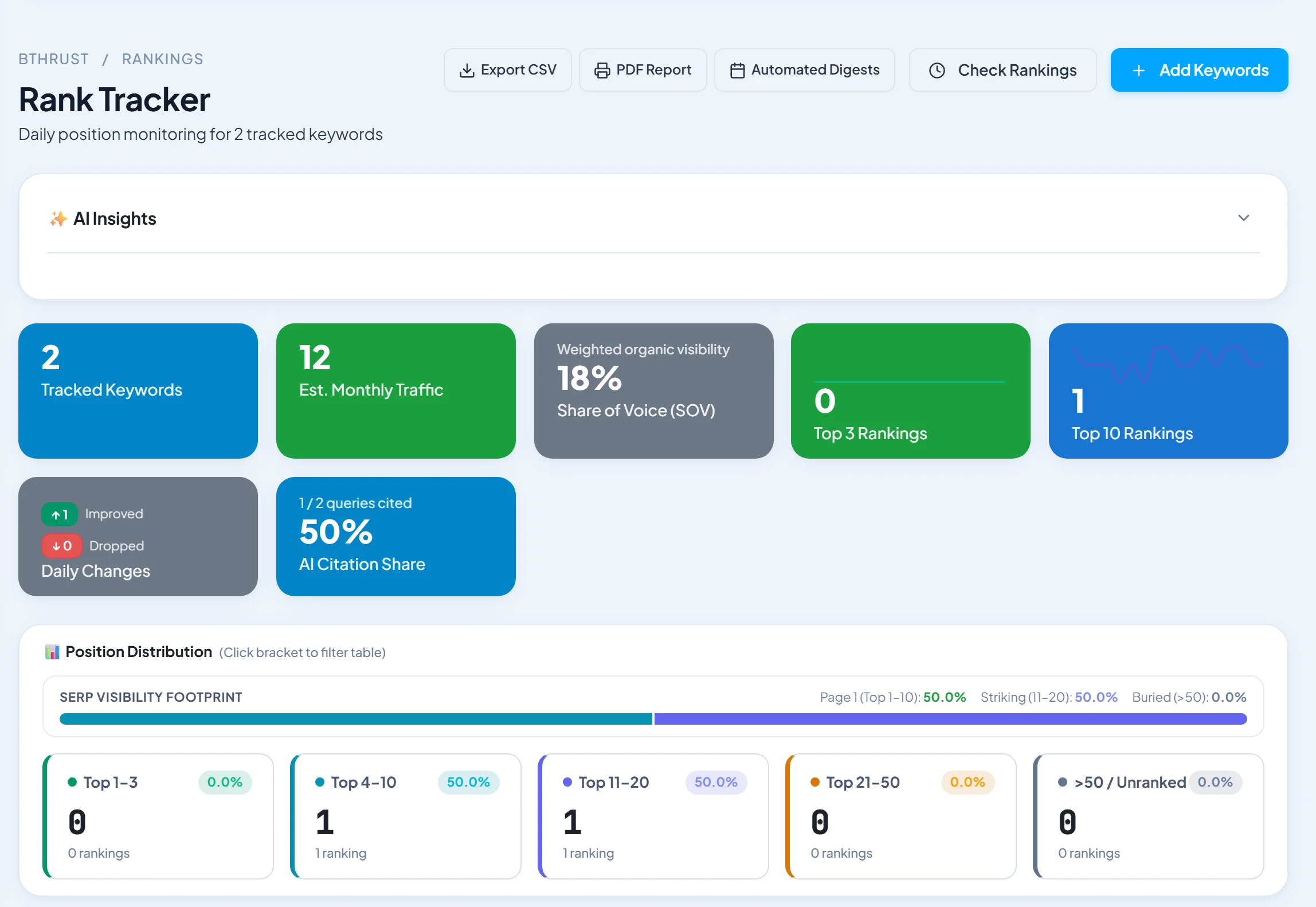
Verdict: the only tool here that puts AI-answer visibility, rank tracking, site audit, local SEO, Google Ads and white-label client reports in the same project. That matters most for agencies, who need to report everything in one place.
Best for: agencies and in-house teams who want one platform instead of a separate AI tracker.
Key AI visibility features:
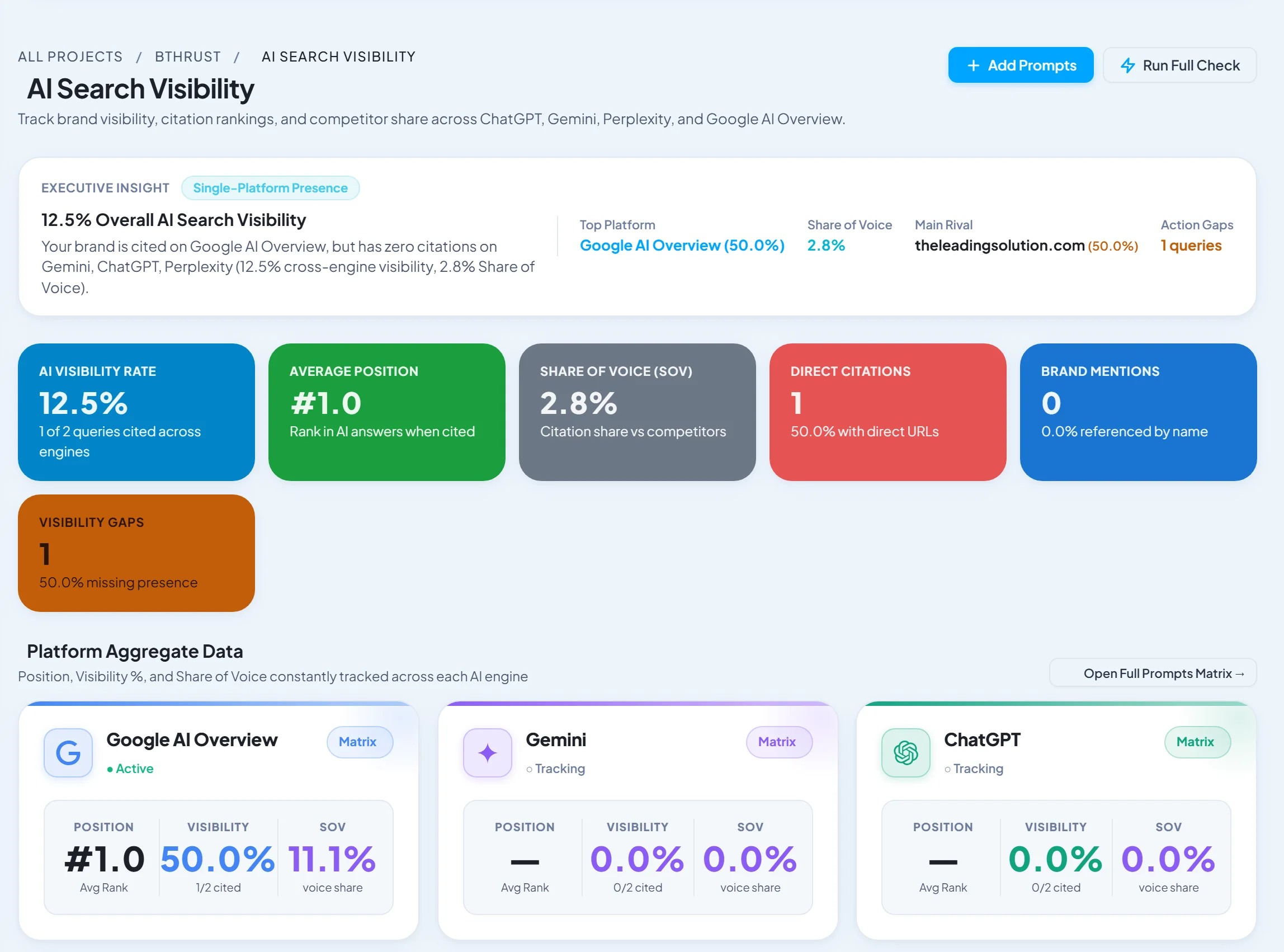
- Track your own prompts (the questions your customers ask) across Google AI Overviews, ChatGPT, Gemini and Perplexity. The engines available depend on plan.
- Engine-by-engine detection of whether your brand is mentioned and whether your site is cited.
- The competitors named instead of you, and the sources AI quotes most.
- An AI-readiness audit: AI-crawler access, llms.txt and content AI can cite, with prioritised fixes.
- Trends over time, shown in the same reports as rankings.
Pricing: AI GEO plans from $29/month (Starter), then Growth $49, Pro $79 and Agency $149. SEO + AI SEO bundles start at $129/month. There is a 14-day free trial, and annual billing saves about 20%. See all plans.
Pros: AI visibility and classic rank in one view; mention vs citation detection; white-label reports and a client role for agencies.
Cons: a newer brand with fewer third-party reviews than the incumbents; fewer engines than Profound at the top end.
2. Profound: best for enterprise brands
Verdict: a specialist built for large brands that need many engines, very large prompt sets and deep analysis of how AI describes them.
Best for: enterprise marketing and communications teams with dedicated budget.
Key features: broad engine coverage; prompt volume and topic research; sentiment and positioning analysis; source and citation analysis; insights on which content AI engines draw on.
Pricing: sales-led; confirm on Profound's site.
Pros: depth of analysis; engine breadth; built for scale.
Cons: enterprise pricing; more than most small teams need; no classic SEO toolkit alongside.
3. Peec AI: best mid-market specialist
Verdict: a focused, easy-to-read AI search analytics tool with sensible entry pricing for marketing teams.
Best for: in-house teams that want a dedicated AI visibility dashboard.
Key features: prompt tracking across major engines; visibility, position and sentiment metrics; competitor benchmarking; source analysis.
Pricing: entry plans around €89/month (verify).
Pros: clear dashboards; strong competitor view; quick setup.
Cons: AI visibility only, so you still need SEO and reporting tools; prompt limits on lower tiers.
4. Otterly.AI: best budget AI tracker
Verdict: an affordable way to start monitoring brand mentions and citations in AI answers.
Best for: small businesses, consultants and agencies testing GEO with a few clients.
Key features: prompt monitoring across ChatGPT, Perplexity and AI Overviews; brand and link citation reports; a GEO audit.
Pricing: entry plan around $29/month (verify).
Pros: low entry price; easy to understand; good for a first proof of concept.
Cons: lighter analysis than enterprise tools; prompt caps on entry plans.
5. Semrush AI Toolkit: best for existing Semrush users
Verdict: a sensible add-on if your team already lives in Semrush and wants AI visibility signals in the same account.
Best for: Semrush customers.
Key features: brand visibility and sentiment in AI answers; competitor comparison; prompt and topic insights.
Pricing: a paid add-on around $99/month on top of a Semrush plan (verify).
Pros: one login for Semrush teams; strong research data around it.
Cons: costs extra on top of an already premium suite; prompt-level control is less granular than specialists.
6. Ahrefs Brand Radar: best for existing Ahrefs users
Verdict: brand-mention intelligence across AI search, built on Ahrefs' data, and useful for market-level share of voice.
Best for: Ahrefs customers who want AI share-of-voice benchmarks.
Key features: brand mentions across AI answers; competitor share of voice; topic exploration.
Pricing: check Ahrefs' site; packaging changes often.
Pros: large dataset; useful for benchmarking a whole market.
Cons: more mention-led than prompt-led tracking; it works best alongside an Ahrefs subscription.
7. Scrunch AI: best for brand and comms teams
Verdict: focused on how AI engines describe and position a brand, which suits communications and brand teams.
Key features: brand presence and positioning monitoring; competitor views; content insights.
Pricing: see Scrunch's site.
Pros: a brand-perception angle; enterprise-ready.
Cons: premium pricing; less suited to agencies reporting many small clients.
8. AthenaHQ: best for recommendations
Verdict: combines AI visibility tracking with guidance on what to change to be recommended more often.
Key features: prompt tracking; competitor analysis; content and optimisation recommendations.
Pricing: see AthenaHQ's site.
Pros: an action-oriented approach.
Cons: pricing aimed at funded teams; no classic SEO data alongside.
9. Rankscale: best for very small budgets
Verdict: one of the lowest-cost ways to put recurring checks on a handful of AI prompts.
Key features: AI search rank and visibility checks; competitor comparison; simple reporting.
Pricing: entry plans around $20/month (verify).
Pros: very low cost; simple.
Cons: limited depth and reporting for agency use.
10. SE Ranking AI Results Tracker: best for existing SE Ranking users
Verdict: adds AI Overviews and LLM visibility to an affordable SEO suite.
Key features: AI answer presence and citations for tracked keywords; competitor comparison; reports in SE Ranking.
Pricing: an add-on to SE Ranking plans (verify).
Pros: good value inside an SEO suite.
Cons: keyword-led rather than prompt-led; fewer engines than specialists.
Mention vs citation: why the difference matters
A mention means the AI names your brand in its answer, for example "Northline Dental is a popular family practice". A citation means the AI links to your website as a source. Mentions build awareness and trust; citations send traffic and show that the AI considers your page authoritative. A brand can be mentioned without being cited (the AI learned about you elsewhere), or cited without being recommended. Track both, because they need different fixes: mentions improve through reviews, PR and third-party coverage, while citations improve through clear, citable pages, structured data and AI-crawler access.
How to choose prompts to track
- Start with buying questions: "best [service] in [city]", "[product] vs [competitor]", "is [brand] good for [use case]".
- Add problem questions your customers ask before they know your brand: "how do I fix [problem]".
- Include brand questions: "[brand] reviews", "[brand] pricing", to check accuracy.
- Keep 20–50 prompts per brand and group them by stage (awareness, consideration, decision).
- Review quarterly: retire prompts nobody asks, and add new ones from sales calls and Search Console queries.
Tracking Perplexity and Gemini
Perplexity cites sources heavily and shows them prominently, so it is the easiest engine to win citations in when your pages answer questions directly. Gemini answers draw on Google's index and Knowledge Graph, so strong classic SEO and consistent entity information (Google Business Profile, schema, reviews) tend to carry over. If your budget covers only two engines, start with Google AI Overviews and ChatGPT for reach, then add Perplexity for citation opportunities and Gemini as Google's assistant grows.
How to report AI visibility to clients
Show three numbers each month: AI visibility rate (the share of tracked prompts where the brand appears), citations (prompts where the site is linked), and AI share of voice versus the top three competitors. Put them next to classic rankings and organic traffic so clients see the whole search picture. In SEO Runway, AI visibility trends appear in the same white-label report as rankings. Our guide to AI SEO tools for agencies covers how to package this as a service.
More AI search guides
- Best GEO tools for optimising content for AI answers
- Tools to track brand mentions in ChatGPT
- Google AI Overviews tracking tools
- AI SEO tools for agencies
- Free AI visibility checkers
- Best rank tracking tools (classic rankings)
Frequently asked questions
How do I know if ChatGPT mentions my brand?
Ask ChatGPT the questions your customers ask and note whether your brand appears. That works for a spot check, but answers vary between sessions, so use an AI visibility tool to run the same prompts on a schedule and record mentions, citations and competitors over time.
Can you track Google AI Overviews?
Yes. Tools such as SEO Runway, Semrush and SE Ranking detect when an AI Overview appears for a query and whether your site is cited in it. See our AI Overviews tracking tools list.
How often do AI answers change?
Often. The same prompt can return different brands from one day to the next. Weekly or more frequent checks, reviewed as trends rather than single results, give a reliable picture.
What is AI share of voice?
The percentage of AI answers, across your tracked prompts, that mention your brand compared with competitors. It is the AI-search equivalent of share of voice in classic rankings.
Is AI visibility tracking accurate?
It is directionally reliable when you track enough prompts over time. Single answers vary, so judge trends across 20 or more prompts rather than one result.
Do I still need classic rank tracking?
Yes. Most search traffic still comes from classic results, and AI answers often draw on pages that already rank well. Track both, ideally in one tool.
The bottom line
- Agencies and teams who want everything in one place: SEO Runway, for AI visibility, rank, audit and white-label reports in one project.
- Enterprise brands: Profound.
- Mid-market teams wanting a specialist: Peec AI.
- Tight budgets: Otterly.AI or Rankscale.
- Already on Semrush, Ahrefs or SE Ranking: start with their AI add-ons.
Want to see where AI engines mention you today? Start a 14-day free trial of SEO Runway and add your first prompts in minutes, or see how AI search tracking works.