Short answer: AccuRanker is the fastest and most scalable pure rank tracker. SEO Runway is the best choice if you want classic Google positions and AI-answer visibility (AI Overviews, ChatGPT, Gemini, Perplexity) in one view, with audits alongside. SE Ranking offers the best value among established suites.
Disclosure: SEO Runway is our product. We ranked it using the same criteria as every other tool, and noted where others do better.
Quick picks
- Fastest and most scalable: AccuRanker
- Best for rank + AI visibility together: SEO Runway
- Best value: SE Ranking
- Best inside a research suite: Semrush Position Tracking
- Best budget: Wincher or SERPWatcher
Rank tracking tools compared
| Tool | Updates | Per 500 keywords | Mobile | City/ZIP | SERP features | AI answers | API |
|---|---|---|---|---|---|---|---|
| AccuRanker | Daily + on demand | ~$116* | Yes | Yes | Yes | AI Overviews* | Yes |
| SEO Runway | Plan schedule + on demand | [verify] | Yes | Yes | Check | AI Overviews, ChatGPT, Gemini, Perplexity | No |
| Semrush Position Tracking | Daily | In plan* | Yes | Yes | Yes | AI Overviews | Higher plans |
| SE Ranking | Daily / every 3 days | ~$65* | Yes | Yes | Yes | Add-on | Yes |
| Ahrefs Rank Tracker | Weekly–daily by plan | In plan* | Yes | Yes | Yes | AI Overviews | Higher plans |
| Nightwatch | Daily | ~$39* | Yes | Yes | Yes | Check | Yes |
| Wincher | Daily | ~$29* | Yes | Yes | Partial | Check | Yes |
| SERPWatcher | Daily | In Mangools plan* | Yes | Yes | Partial | No | No |
| Keyword.com | Daily + on demand | See site* | Yes | Yes | Yes | Check | Yes |
| ProRankTracker | Daily | See site* | Yes | Yes | Partial | Check | Yes |
*Approximate; verify. Suites include rank tracking within keyword limits per plan.
How we chose these tools
We compared each tracker's published features, plans and documentation on six criteria:
- Update frequency: daily as standard, with on-demand refreshes a bonus.
- Desktop and mobile tracked separately.
- Location granularity: country, city and ZIP or postcode.
- SERP feature tracking: featured snippets, map packs, AI Overviews.
- History and exports for reporting.
- Price per 500 keywords tracked daily.
1. AccuRanker: fastest and most scalable
Verdict: the speed benchmark, with instant refreshes, large volumes and unlimited users.
Best for: SEOs and agencies tracking thousands of keywords who want rank data only.
Key features: daily plus on-demand updates; SERP feature tracking; segmentation with tags; GA and GSC integrations; API.
Pricing: priced by keyword volume (verify on AccuRanker's pricing page).
Pros: speed; reliability; unlimited users.
Cons: rank tracking only; can be expensive at low volumes.
2. SEO Runway: best for rank and AI visibility in one view
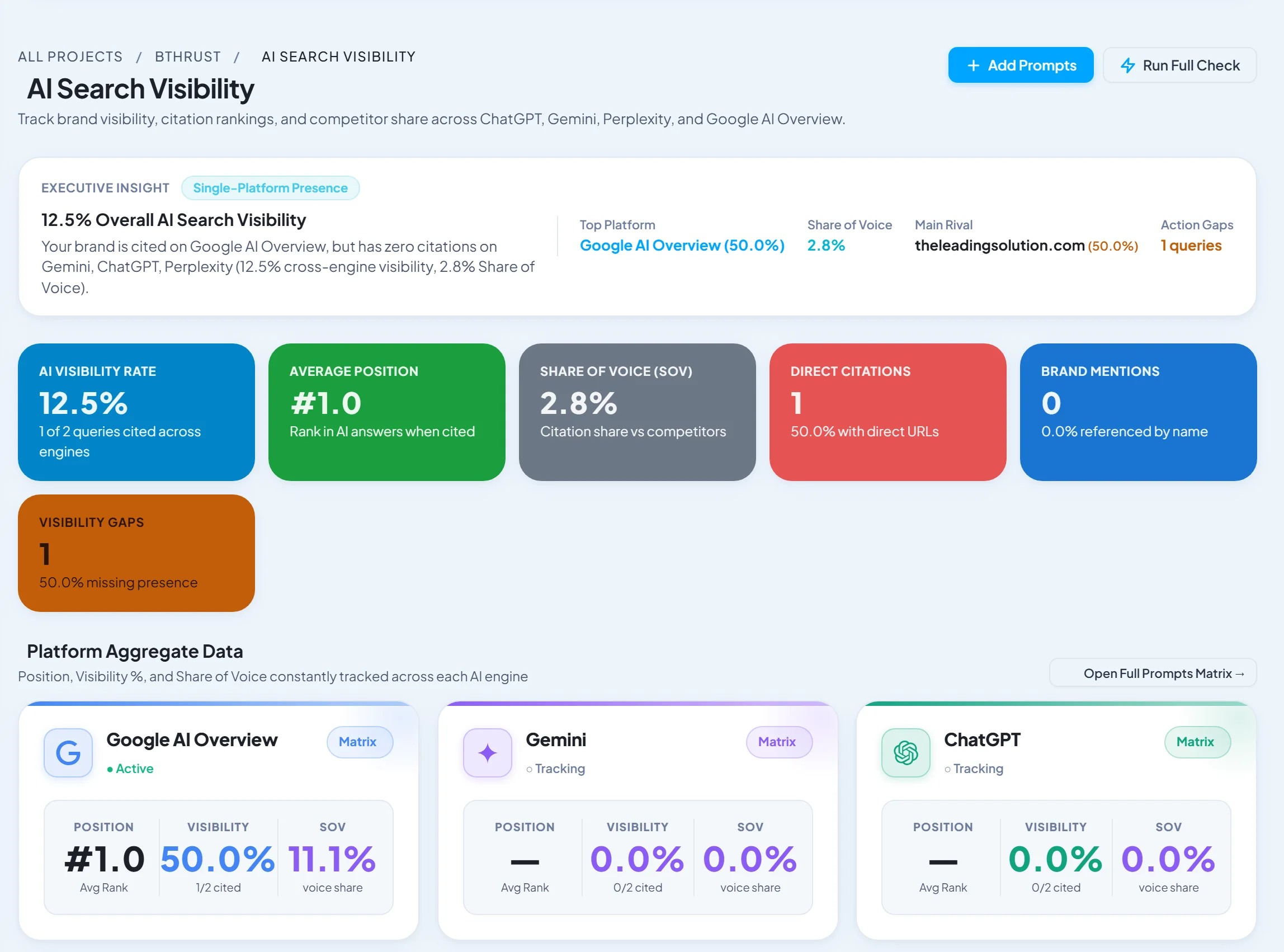
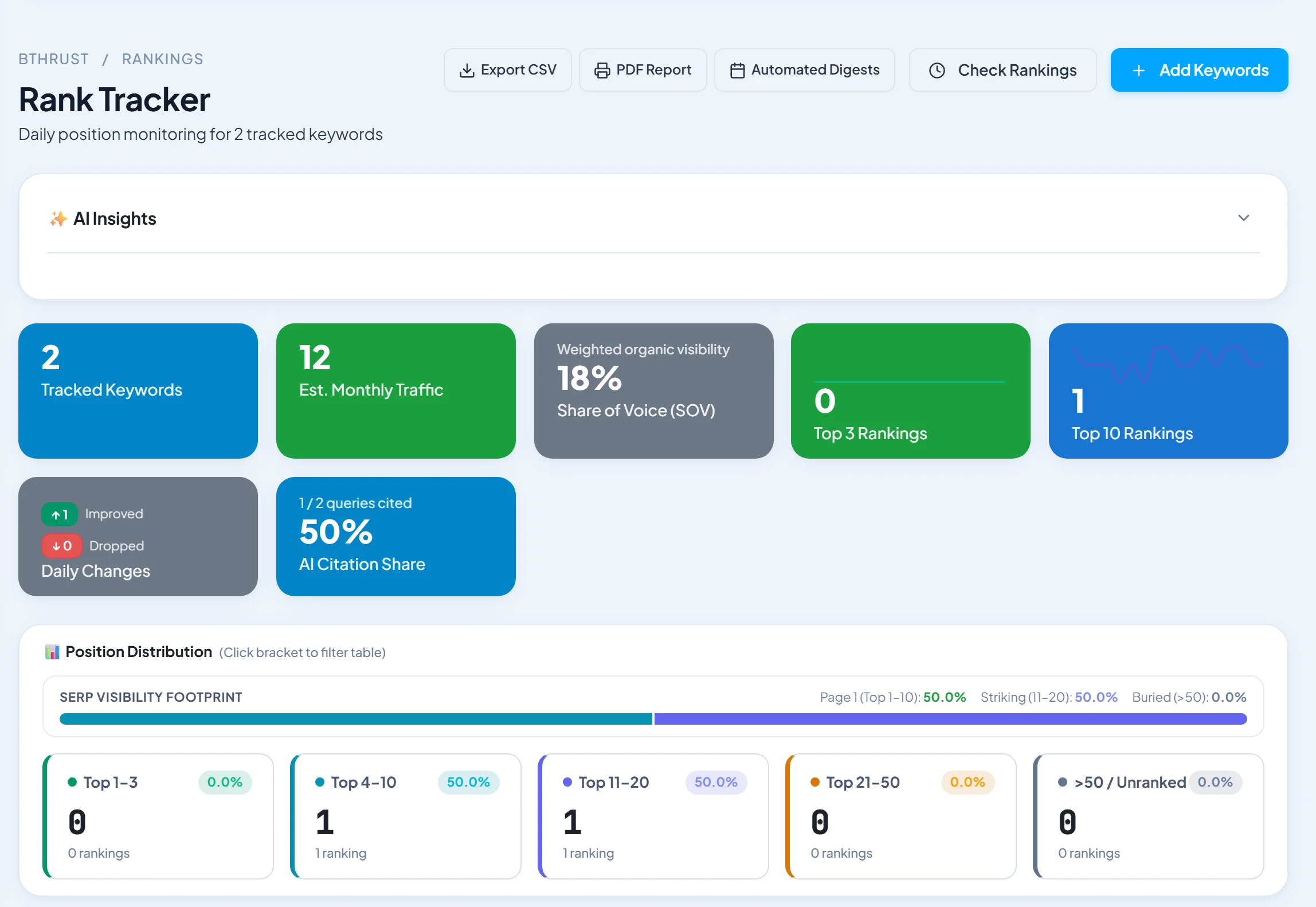
Verdict: tracks classic positions by device and location, and in the same project tracks whether AI engines mention or cite you, so you see the whole search picture.
Best for: teams and agencies that need rankings next to AI visibility, audits and reports.
Key features:
- Device- and location-level tracking (city/ZIP), position history, winners and losers.
- Share of voice and competitor positions.
- Checks on your plan's schedule plus on-demand checks.
- AI visibility across Google AI Overviews, ChatGPT, Gemini and Perplexity (by plan).
- Keyword research that sends terms straight to the tracker.
Pricing: Core SEO from $49/month; SEO + AI bundles from $129; 14-day free trial. See plans.
Pros: classic and AI search together; audits and reports in the same place.
Cons: no Bing tracking; no public API; slower on-demand refreshes than AccuRanker at very high volume.
3. Semrush Position Tracking: best inside a research suite
Verdict: dependable tracking with SERP features and competitor views, alongside the deepest research data.
Pricing: included in Semrush plans from about $139/month (verify).
Pros: research context; SERP features.
Cons: keyword limits on lower plans; per-user pricing.
4. SE Ranking: best value
Verdict: accurate, flexible tracking at a good price, with a full SEO suite around it.
Pricing: from about $65/month, with the price set by update frequency and keyword count (verify).
Pros: value; frequency options.
Cons: AI tracking is an add-on.
5. Ahrefs Rank Tracker: best for Ahrefs users
Verdict: solid tracking tied to Ahrefs' research tools.
Pricing: included in Ahrefs plans; update frequency depends on plan (verify).
Pros: integrated with link and keyword data.
Cons: lower plans update less often.
6. Nightwatch: best for segmentation
Verdict: powerful views and segments with good local tracking.
Pricing: from around $39/month (verify).
Pros: segmentation; local.
Cons: few tools beyond rank.
7. Wincher: best budget daily tracker
Verdict: simple, affordable daily tracking.
Pricing: from around $29/month (verify).
Pros: price; ease.
Cons: lighter SERP feature data.
8. SERPWatcher (Mangools): best for beginners
Verdict: a friendly tracker bundled with Mangools' keyword tools.
Pricing: included in Mangools plans (verify).
Pros: clean interface; bundled tools.
Cons: limited for scale.
9. Keyword.com: best simple tracker with on-demand refresh
Verdict: straightforward tracking with on-demand updates and share links.
Pricing: see Keyword.com's site.
Pros: simple; unlimited users.
Cons: rank only.
10. ProRankTracker: best for many search engines
Verdict: tracks across multiple search engines and locations.
Pricing: see ProRankTracker's site.
Pros: engine breadth.
Cons: a dated interface.
How rank trackers get their data, and why results differ
Rank trackers run Google searches from data centres or proxy networks, set to a specific country, city, device and language, and record where your URL appears. Results differ between tools, and from what you see in your own browser, because of:
- Location: a city-level check and a country-level check return different results.
- Device: mobile and desktop results differ, sometimes a lot.
- Personalisation: your own searches are shaped by history and signed-in state.
- Timing: Google tests and shuffles results throughout the day.
- How positions are counted: some tools count map packs and SERP features as positions; others don't.
Pick one tool, keep its settings fixed, and watch the trend.
Mobile vs desktop tracking
Google indexes mobile-first, and most searches happen on phones, so track mobile by default. Add desktop for B2B keywords, where buyers often research at work. Big gaps between the two usually point to mobile usability or page speed problems.
Daily vs on-demand checks
Daily checks give you a clean history and catch drops quickly. On-demand checks help after you publish or change a page and want to see the effect without waiting. For most sites, daily (or every few days for low-priority keywords) is enough.
Tracking AI Overviews and AI answers alongside rank
A #1 position can sit below a Google AI Overview that answers the query, and ChatGPT or Perplexity may recommend competitors without showing a results page at all. Track whether an AI Overview appears for each keyword, whether you are cited in it, and, for key buying questions, whether AI assistants mention you. See our AI Overviews tracking tools.
More rank tracking guides
- Rank trackers for agencies (white-label reports)
- Local rank trackers for city and ZIP tracking
- Affordable rank trackers
- Free rank checkers
- Geo-grid trackers for Google Maps
- Keyword research tools to find what to track
Frequently asked questions
How accurate are rank trackers?
Reputable trackers are accurate for the location and device they simulate. Differences come from settings, personalisation and timing, so compare trends from one tool rather than single results across tools.
How often should I track rankings?
Daily for priority keywords; weekly is fine for long-tail terms. Report monthly to avoid reacting to normal fluctuations.
Why does my rank differ from what I see in Google?
Your own results are personalised by location, history and device. Rank trackers use neutral, fixed settings, which better represent the average searcher.
Do rank trackers track AI Overviews?
Many now do, showing whether an AI Overview appears and whether you are cited. SEO Runway also tracks ChatGPT, Gemini and Perplexity answers for your prompts.
How many keywords should I track?
Small sites usually track 50–200 keywords; larger sites track thousands. Track every keyword that maps to a page you want to rank, and group them by topic.
The bottom line
- High-volume, rank-only tracking: AccuRanker.
- Rank and AI visibility with audits and reports: SEO Runway.
- Best value suite: SE Ranking.
- Already in Semrush or Ahrefs: use their trackers.
- Small budgets: Wincher or SERPWatcher.
Start a 14-day free trial of SEO Runway to track rankings and AI answers together, or see the SEO workspace.