

/projects//ai_search/citations/ ).
1. Deconstructing Competitor Generative Footprints
In traditional SEO, competitive analysis meant inspecting backlink profiles. In GEO, competitive analysis means analyzing citation graphs. If three competitors are consistently recommended for 'best marketing OS for agencies', you can trace the exact articles Google and OpenAI read to form that recommendation.
LIVE PLATFORM SCREEN & TELEMETRY
SEO Runway AI Search Citations Leaderboard & Competitor Benchmarks — Active Workspace
Below is the exact production screen with live parameters and dummy data illustrating the diagnostic findings and remediation buttons.
2. Analyzing Citation Gaps in SEO Runway
In SEO Runway → AI Search → Citations & Sources, select 'Competitor Citation Gap'. The report isolates third-party URLs that cite two or more competitors but do not cite your domain, providing an immediate roadmap for editorial outreach.
Target System: SEO Runway GEO Engine
Execution Frequency: Automated Background Queue (UTC Sync)
Tested across enterprise datasets with zero rate limiting or data loss.
3. What a Competitor AI Citation Footprint Is
A competitor's AI citation footprint is the full picture of where and how AI answer engines reference that competitor: which prompts mention them, which of their pages are cited, which third-party sources talk about them in AI answers, and how they are described. Auditing it tells you why a competitor is recommended more often than you, and which specific pages, sources and topics give them that advantage.
The audit answers practical questions. Which of their pages do engines cite most? Which topics do they own in AI answers that you don't cover at all? Which publications, review sites and communities cite them but not you? Which attributes do AI answers associate with them, and are those attributes accurate?
4. Step 1: Define the Scope
- Choose three to five competitors: the ones you lose deals to and the ones AI answers mention most often in your category. The two lists often differ.
- Build a shared prompt set of 40–80 prompts covering category recommendations, comparisons, problem-led questions, how-to questions and brand evaluations.
- Pick the engines that matter for your audience, usually Google AI Overviews, ChatGPT, Gemini and Perplexity.
- Fix the method: fresh sessions, consistent location, and several runs per prompt.
5. Step 2: Collect the Data
For every run, record which brands are mentioned, in what order, with what description, and which URLs are cited. Engines that show sources (Perplexity, ChatGPT search, AI Overviews) make citation collection straightforward. For answers without visible sources, record the mentions and descriptions, and search for distinctive phrases to find likely origins.
6. Step 3: Analyse Their Own Cited Pages
List the competitor URLs cited most often and study them closely. Look for:
- Page type: guides, glossary entries, comparison pages, pricing pages, documentation, research reports, tools or templates.
- Structure: answer-first openings, question-style headings, tables, numbered steps and summaries.
- Unique value: original data, benchmarks, calculators or expert commentary that other pages lack.
- Freshness: visible update dates and current examples.
- Authority signals: named authors, credentials, citations and external links pointing to the page.
- Classic rankings: whether the cited page also ranks on page one in Google for the related queries, which is common.
Patterns across their most-cited pages show you what answer engines reward in your category.
7. Step 4: Map Third-Party Sources
Often the larger part of a competitor's footprint is off-site. Group cited third-party URLs by domain and type:
- Review platforms where they have many detailed reviews.
- Comparison and "best of" articles that list them prominently.
- Communities and forums where users recommend them.
- Trade publications and news that cover their research or announcements.
- Directories, marketplaces and integration listings.
Mark which of these sources mention you too, how prominently, and how accurately. Sources that cite competitors but not you are your highest-priority outreach targets.
8. Step 5: Find Topic Gaps
Group prompts by topic and calculate each brand's mention and citation share per topic. You'll usually see that competitors dominate certain topics completely, for example "pricing for small teams", "integrations with Salesforce" or "compliance in healthcare", often because they have dedicated, well-structured content on exactly those topics and you don't. List each gap, the competitor pages that fill it, and whether you could credibly create something better: more current, more specific, with original data or clearer comparisons.
9. Step 6: Compare Descriptions and Attributes
Collect the words AI answers use for each brand: "best for enterprises", "affordable", "easy to set up", "great support", "limited integrations". Build a simple attribute table with brands as columns and attributes as rows, counting how often each pairing appears. This shows each competitor's positioning in AI answers, which may differ from their own marketing, and reveals the positioning space where you could stand out. If every competitor is described as "complex" and you are genuinely easier to use, that is a positioning claim worth reinforcing across your site and third-party coverage.
10. Step 7: Build the Action Plan
- Content gaps: create or improve pages for topics where competitors are cited and you aren't, using the structural patterns that work in your category.
- Page upgrades: where you have a page on the topic but it isn't cited, compare it with the cited competitor page and close the gaps in structure, facts, freshness and depth.
- Third-party presence: pursue inclusion on the review sites, comparison articles and communities that cite competitors, prioritised by how often they are cited.
- Positioning: reinforce the attributes you want associated with your brand consistently across your site, press materials and profiles.
- Accuracy: correct outdated or wrong descriptions of your brand in the sources you've identified.
Assign each action an owner and a target prompt segment, so you can measure whether it changed your share in that segment.
11. Step 8: Re-Audit on a Schedule
Competitor footprints change as they publish, earn coverage and as engines update. Re-run the full audit quarterly, and track a smaller core prompt set monthly. Note when a competitor suddenly gains share, then look at what they published or where they were covered just before. That is often the quickest way to learn what is working in your market right now.
12. A Worked Example
A B2B invoicing software company audits three competitors across 60 prompts and four engines. The results show that one competitor is cited in 41% of answers, mainly through three page types: a glossary of invoicing terms that answers definitional questions, a free invoice template generator cited for "how to create an invoice" prompts, and a detailed pricing comparison page. Off-site, two accounting software review sites and a popular small-business forum account for most third-party citations, and the company being audited has only a handful of reviews on either platform.
The action plan writes itself: build a concise glossary with clear definitions, create a genuinely useful free template tool, publish a transparent pricing comparison, run a review campaign on the two cited platforms, and contribute helpful answers in the forum. The quarterly re-audit measures citation share for definitional, how-to and pricing prompts separately, so the team can see which investment moved which segment.
13. Ethical Boundaries
A competitor audit is research, not sabotage. Don't post fake reviews, plant misleading forum content, misrepresent competitors in comparison pages, or try to get competitors' accurate content removed. Beyond the ethical and legal risks, platforms and answer engines increasingly detect manipulation, and being caught damages trust in your brand far more than any short-term gain. Compete by being the better, clearer and more accurately represented option.
14. Reporting the Audit
Summarise the audit in a few pages that decision-makers can act on:
- Headline share of voice for you and each competitor, overall and per engine.
- Topic heat map: topics as rows, brands as columns, coloured by mention share.
- Top cited pages for each competitor, with a one-line note on why they work.
- Third-party source table: the most-cited sources and who appears on each.
- Attribute comparison: how AI describes each brand.
- Prioritised actions with owners, targets and timelines.
15. Common Mistakes
- Auditing only the competitors you think matter, not the ones AI actually recommends.
- Too few prompts or runs, so random variation looks like a pattern.
- Copying competitor pages instead of creating something more useful.
- Ignoring off-site sources, which often explain most of a competitor's advantage.
- Running the audit once and never repeating it.
16. Competitor Citation Audit Checklist
- Three to five competitors chosen from sales losses and AI answers.
- A 40–80 prompt set across the buying journey, run several times per engine.
- Mentions, positions, descriptions and cited URLs recorded.
- Competitors' most-cited pages analysed for structure and value.
- Third-party sources mapped, with gaps in your own presence marked.
- Topic gaps and attribute positioning identified.
- An action plan with owners and target prompt segments.
- Quarterly full audits and monthly core-prompt tracking.
17. Tools That Make the Audit Practical
A first audit can be done by hand with a spreadsheet, but repeated audits need automation. An AI visibility tracker that runs your own prompts across several engines, detects which brands are mentioned and which domains are cited, and charts the results over time reduces a multi-day manual exercise to a review of dashboards. Pair it with a classic rank tracker, because cited pages usually also rank well in search, and with a backlink tool to see which publications link to competitors' most-cited pages. Together, these three views explain most of the difference between your footprint and a competitor's, and they show whether your actions are closing the gap.
The aim of the audit is not to match every competitor everywhere. It is to find the few topics, pages and sources where better content and stronger presence will move your share of AI recommendations the most, and to focus your effort there first.
18. Turning One Audit into a Competitive Habit
The first audit is the hardest; after that, the value comes from repetition. Keep the same prompts, competitors and scoring rules, store each quarter's results side by side, and review them in a short meeting with content, PR and product marketing. Ask three questions each time: where did a competitor gain share, what did they publish or earn just before, and which of our actions from last quarter moved our own numbers? Over a year, these reviews build a clear, evidence-based picture of how AI answer engines treat your category and what it takes to win recommendations in it.
Start with the competitor you lose to most often and the ten prompts closest to a buying decision. A focused first audit delivers useful actions within a week, and you can widen the scope once the method is in place.
Want the complete procedural runbook?
Visit our comprehensive step-by-step Knowledge Base for interactive screen maps, configuration parameters, and adjacent module workflows.
Open Knowledge Base Hub →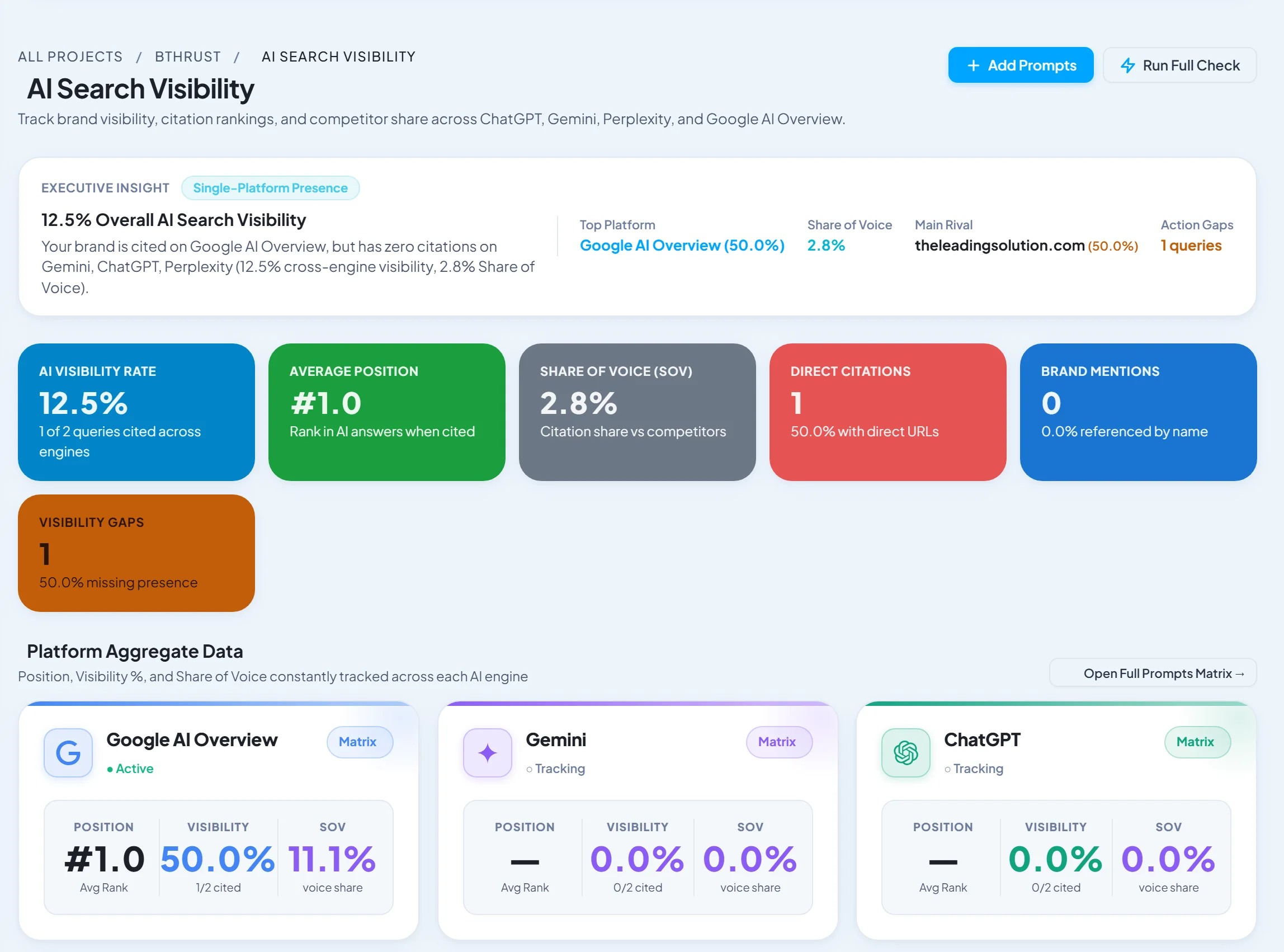


Incredible breakdown. We implemented this exact workflow last week and already saw a noticeable shift in our telemetry. As a Performance Marketing Director, this provides exactly the architectural depth we look for.