

/projects//content/editor/ ).
1. Entity Salience vs Keyword Frequency
Mentioning a keyword 20 times does not make a document authoritative. In modern NLP models (BERT, MUM, Gemini), entity salience is derived from syntax dependency trees, heading placement, and semantic relationships. A page that establishes clear subject-predicate-object relations achieves a higher salience score with fewer keyword mentions.
LIVE PLATFORM SCREEN & TELEMETRY
SEO Runway Content Studio NLP Entity Density Analyzer — Active Workspace
Below is the exact production screen with live parameters and dummy data illustrating the diagnostic findings and remediation buttons.
2. Live Entity Scoring in SEO Runway
In SEO Runway → Content Studio, write or paste your draft into the editor. The NLP Entity Panel on the right rail displays all recognized entities categorized by Salience (High, Moderate, Marginal) and flags missing contextual entities used by top competitors.
Target System: SEO Runway GEO Engine
Execution Frequency: Automated Background Queue (UTC Sync)
Tested across enterprise datasets with zero rate limiting or data loss.
3. What Entity Salience Is
When natural language systems analyse a page, they identify the entities it mentions (people, organisations, products, places, concepts) and estimate how central each one is to the text. That centrality score is called salience. Google's Cloud Natural Language API exposes it directly: for any text, it returns the entities it recognises with a salience score between 0 and 1, where higher means more central to the document.
Google hasn't said its search ranking uses that exact API, but the underlying idea is fundamental to how modern search and AI systems understand content. A page that is clearly about one main entity, with related entities supporting it, is easier to classify, match to queries and summarise accurately than a page that mentions many things without a clear focus.
4. Why Salience Matters for SEO and AI Search
- Topic clarity: a page about "project management software for agencies" should make that entity (and the agency context) dominant, rather than drifting into generic productivity advice.
- Disambiguation: when your brand is mentioned alongside the right related entities, such as your category, location, founders and products, systems are more likely to identify it correctly.
- AI summaries: generative engines summarise pages by their main entities and claims. A page with a clear focus is summarised more accurately and attributed more confidently.
- Query matching: queries increasingly map to entities and their attributes ("price of X", "X vs Y"). Pages that state those attributes clearly about the right entity are easier to retrieve.
5. Measuring Salience on Your Pages
- Extract the main content of a page, without navigation, footers and sidebars, which add noise.
- Run it through an entity analysis tool, such as the Google Cloud Natural Language API's entity analysis, to get the entities and their salience scores.
- Check the top entity. Is the most salient entity the one the page is meant to be about? If a product page's top entity is a generic word or a competitor, the page's focus is unclear.
- Compare with top-ranking pages. Run the same analysis on pages ranking for your target query. Note which entities they consistently include and how prominent they are.
- Look for missing related entities. Entities that appear across most competing pages but are missing from yours often point to subtopics you haven't covered.
6. Writing Techniques That Increase Salience
Name the main entity early and explicitly
Use the full name of the main entity in the title, the H1 and the first sentence. Pronouns and vague references ("this tool", "it", "the platform") are fine later, but the opening should leave no doubt what the page is about.
Make the entity the grammatical subject
Sentences where the main entity is the subject ("Acme Analytics tracks rankings daily") signal centrality more strongly than sentences where it appears in passing ("Daily ranking checks are available in tools like Acme Analytics").
State attributes directly
Spell out the facts people search for: what it is, who it is for, what it costs, where it operates, what it integrates with, how it compares. Each clear attribute statement strengthens the link between the entity and the facts.
Include relevant related entities
Mention the entities that genuinely belong in the topic: the category, common alternatives, integrations, standards and locations. Relationships between entities help systems place yours correctly in the knowledge graph.
Cut unrelated tangents
Long digressions about other topics dilute focus. If a section isn't about the main entity or its direct context, it probably belongs on another page.
Use consistent naming
Pick one name for your product and use it everywhere. Switching between "Acme", "Acme Analytics", "AcmeAI" and "the Acme suite" splits signals between what look like different entities.
7. Structural Signals That Reinforce Salience
- Headings: include the main entity, or its key attributes, in several H2s ("Acme Analytics pricing", "How Acme Analytics compares with X").
- Structured data: mark up the main entity with the right schema type (Product, SoftwareApplication, Organization, LocalBusiness, Person) and connect it to related entities with properties such as
brand,manufacturer,authorandabout. - Internal links: link to the page from other pages using anchor text that names the entity, and link out from it to pages about related entities.
- Images and captions: descriptive alt text and captions naming the entity add supporting context.
- One main entity per page: where possible, give each important entity its own page rather than covering several equally on one page.
8. Building an Entity-Based Content Strategy
- List your core entities: your brand, products, services, key people, locations and the main concepts in your field.
- Map each entity to one primary page that is clearly about it, such as a product page, service page, location page or glossary entry.
- Define the attributes each page must state, based on what users search for and what competing pages cover.
- Map relationships between entities and reflect them in internal links and structured data.
- Audit salience on each primary page and fix pages where the intended entity isn't dominant.
- Keep facts consistent across your site and external profiles, so every source describes the entity in the same way.
9. A Before-and-After Example
Consider a service page for a commercial cleaning company in Leeds. The original page opened with three paragraphs about why cleanliness matters in general, mentioned "our team" and "we" throughout without naming the business, and listed services in a single long sentence. An entity analysis showed the most salient entities were generic concepts such as "cleanliness", "workplace" and "health", with the company and Leeds barely registering.
The revised page opened with "Brightside Commercial Cleaning provides office, retail and healthcare cleaning across Leeds and West Yorkshire." It added H2s for each service type, a section on service areas naming specific districts, and a short "About Brightside" section with founding year and accreditations. It also included LocalBusiness schema with the same name, address and service area. After the rewrite, the company and Leeds became the top entities in the analysis, and the page's focus matched exactly what local searchers were asking for.
10. Salience and AI-Generated Answers
Answer engines summarise and quote passages. When a passage clearly states "Entity X does Y for Z at price P", it can be lifted into an answer with confidence and attributed correctly. When the same information is spread across paragraphs that refer to "it" and "our solution", the engine must infer the subject, which raises the chance of errors or of the passage being skipped. Writing with high salience is therefore not only an SEO technique; it directly affects whether AI answers describe your brand accurately.
11. Common Mistakes
- Chasing a score instead of clarity. Repeating the entity name unnaturally to push salience up makes pages worse for readers without helping understanding.
- Inconsistent product naming across pages, ads and profiles.
- Burying the subject under long generic introductions.
- Covering several main entities equally on one page, leaving none clearly dominant.
- Schema that names a different entity from the visible content, or a generic type when a specific one exists.
- Ignoring related entities that users and competitors consistently mention.
12. Entity Salience Checklist
- One main entity per important page, named in the title, H1 and first sentence.
- The main entity used as the subject of key sentences.
- Key attributes stated explicitly.
- Relevant related entities included; tangents removed.
- Consistent naming across the site and external profiles.
- Structured data with the correct type and entity relationships.
- Descriptive internal anchors pointing to each entity's primary page.
- Entity analysis run on priority pages and compared with competitors.
13. Scaling Entity Audits Across a Site
Running entity analysis page by page doesn't scale beyond a few dozen URLs, but a simple automated workflow does. Export the main content of every page you care about from your crawler (most crawlers can extract the article body with a CSS selector), send each text to an entity analysis API in a batch script, and store the top five entities and their salience scores per URL in a spreadsheet. Then add a column for the intended main entity of each page. Sorting by "intended entity not in top two" gives you a prioritised list of pages whose focus is unclear.
Repeat the audit after major content updates and once or twice a year. Entity drift is common: pages that started focused often accumulate tangential sections, promotional blocks and outdated references until their main subject is no longer the most prominent thing on the page. Periodic audits catch that drift before it affects how search and AI systems understand your content.
Entity salience is ultimately a discipline of clear writing: decide what each page is about, say it plainly, support it with the right related facts, and remove what doesn't belong. Pages written that way serve readers, search engines and AI systems equally well.
14. Entities Beyond Your Own Pages
Salience on your site is only part of the picture. Search engines and AI systems also learn about your entities from how other sites describe them. When a review site, a news article or a partner page mentions your brand, the surrounding text tells systems what your brand is associated with. Encourage clear, accurate descriptions in third-party coverage: provide journalists and partners with a short factual boilerplate (what you do, for whom, where), keep profiles on directories and review platforms consistent with your website, and correct outdated descriptions when you find them. A brand that is described the same way on its own site and across the wider web becomes a much clearer, more confidently understood entity.
Want the complete procedural runbook?
Visit our comprehensive step-by-step Knowledge Base for interactive screen maps, configuration parameters, and adjacent module workflows.
Open Knowledge Base Hub →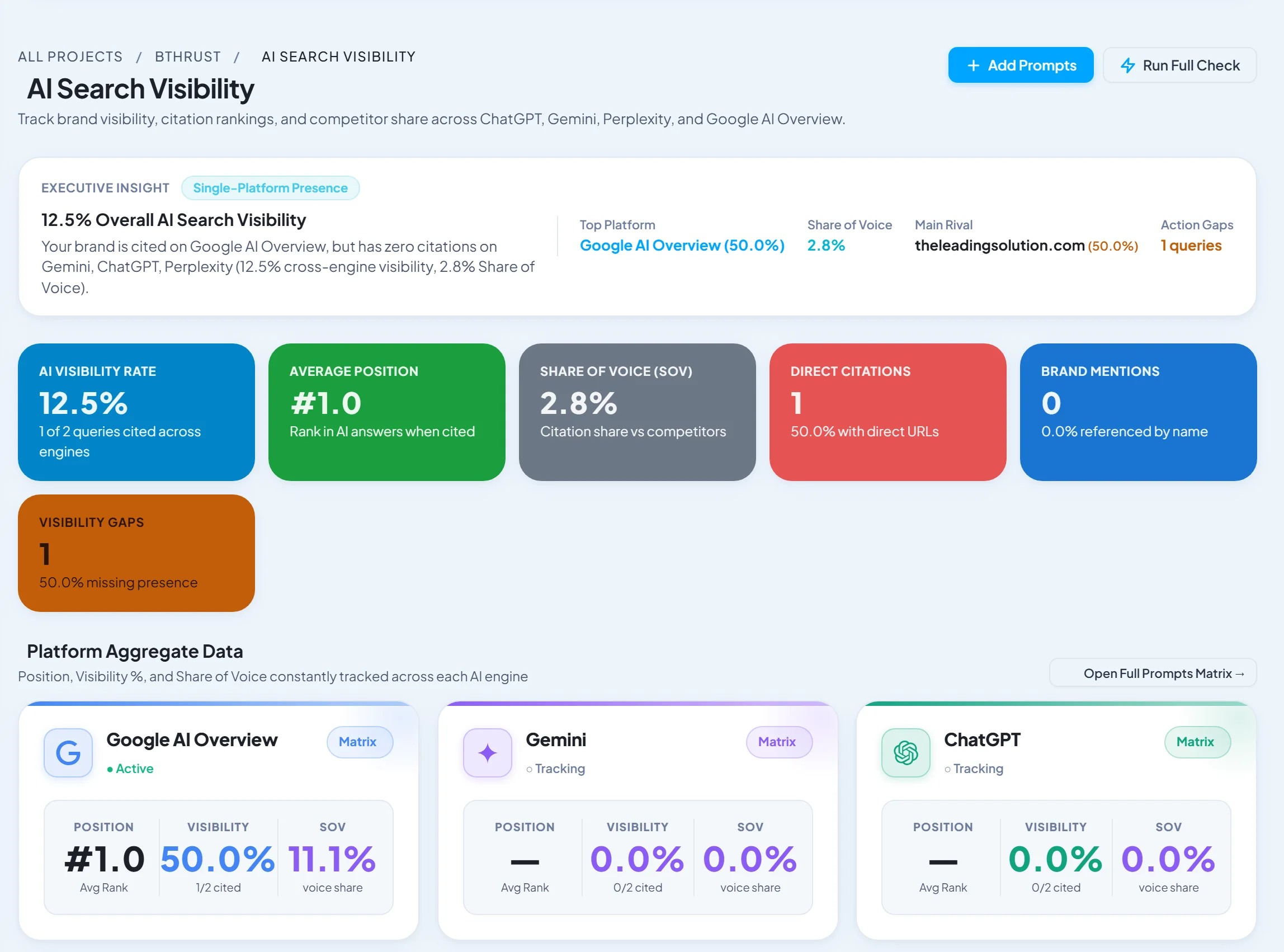


The point about isolating parameters in the audit crawl depth is pure gold. Saved our engineering team dozens of hours. As a VP Marketing, CloudScale, this provides exactly the architectural depth we look for.