

/projects//ai_search/readiness/ ).
1. What Is the /llms.txt Standard?
Proposed as an open standard for generative engine optimization, /llms.txt resides in the root directory of a web server (e.g. https://yourdomain.com/llms.txt). It provides an authoritative, human-curated summary of your company's core services, technical specifications, and key URLs in structured markdown.
LIVE PLATFORM SCREEN & TELEMETRY
SEO Runway AI Search Readiness Audit & llms.txt Generator — Active Workspace
Below is the exact production screen with live parameters and dummy data illustrating the diagnostic findings and remediation buttons.
2. Generating Your llms.txt in SEO Runway
In SEO Runway → AI Search → Readiness Audit, click 'Generate llms.txt'. The platform analyzes your site's primary value propositions and generates valid markdown ready to upload to your web root in under 30 seconds.
Target System: SEO Runway GEO Engine
Execution Frequency: Automated Background Queue (UTC Sync)
Tested across enterprise datasets with zero rate limiting or data loss.
3. What llms.txt Is
llms.txt is a proposed standard for a Markdown file placed at the root of a website (/llms.txt) that gives large language models a concise, curated guide to the site. It was proposed in 2024 as a way to help AI tools find a site's most useful content without parsing complex HTML pages full of navigation, scripts and ads.
A typical llms.txt file contains:
- An H1 heading with the site or project name.
- A short blockquote summarising what the site or organisation does.
- Optional paragraphs with key context, such as what the product is and who it is for.
- H2 sections with lists of links to the most important pages, each with a short description.
- An optional "Optional" section for secondary resources that can be skipped when context is limited.
Some sites also publish an llms-full.txt containing the full text of key documentation in one file, and Markdown versions of individual pages (for example by appending .md to a URL).
4. What llms.txt Does and Doesn't Do
It is important to be realistic. llms.txt is a community proposal, not an official web standard, and major AI search providers have not confirmed that they use it when deciding what to cite or rank. In practice:
- It does not replace robots.txt. It doesn't grant or deny crawling permission. Access control still belongs in robots.txt and server rules.
- It is not a ranking signal in traditional search, and there is no evidence it is one in AI search.
- It can help tools that read it, such as coding assistants, documentation tools and agents that fetch a site's llms.txt to understand it quickly. For developer-facing products in particular, a good llms.txt makes your docs easier to use inside AI tools.
- It is low-cost. Writing one takes an hour or two, and it does no harm.
Treat it as a helpful, optional layer on top of the fundamentals that clearly matter: crawlable pages, clear content and accurate information.
5. Writing an Effective llms.txt
- Start with a precise summary. In two or three sentences, state what your organisation does, for whom and what makes it distinct. This is the text most likely to be read in full.
- Select the most useful pages, not every page: product overviews, pricing, key documentation, setup guides, policies, and authoritative guides on your core topics.
- Describe each link. A short description after each link ("Pricing: plans, limits and what each includes") helps a model choose the right page.
- Organise by user need, such as "Getting started", "Product", "Pricing and plans", "Guides" and "Company", rather than by your site's navigation.
- Link to clean versions where possible. If you can serve Markdown or plain-text versions of key pages, link to those.
- Keep facts consistent with your website. The summary and descriptions must match current pricing, product names and positioning.
6. Deploying and Maintaining the File
- Serve it at the root as
/llms.txtwith a 200 status and atext/plainortext/markdowncontent type. - Don't block it. Make sure robots.txt and any bot protection allow AI tools to fetch it.
- Generate it from your CMS where possible, so new key pages and changed descriptions update automatically. Otherwise, add it to your content review checklist.
- Review it quarterly and after any product, pricing or positioning change.
- Version it in source control, like robots.txt, so changes are reviewed.
7. The Fundamentals That Matter More
If you only have time for a few improvements, these have a clearer effect on how AI crawlers and answer engines understand your site:
- Crawler access: robots.txt rules for AI search crawlers (such as OAI-SearchBot and PerplexityBot) that match your goals, and no accidental blocks from firewalls or bot protection.
- Content in HTML: key information present without relying on JavaScript rendering.
- Answer-first pages: each important page opens with a clear statement of what it covers or answers.
- Structured data: Organization, Product, FAQ and Article markup where relevant, kept consistent with visible content.
- Accurate, consistent facts: pricing, features and company details that match across your site, profiles and third-party listings.
- Authority: mentions and links from sources answer engines already trust.
An AI-readiness audit that checks AI-crawler access, the presence of llms.txt and whether key pages contain citable content covers these basics in one pass.
8. Measuring Whether It Helps
Because llms.txt's effect is uncertain, measure rather than assume. Check server logs for requests to /llms.txt and note which user agents fetch it. Track whether AI tools describe your product accurately when asked, and whether referral traffic from AI tools changes after you publish or improve the file. If logs show no AI crawler ever requests it, that is useful information too: your effort is better spent on content and crawlability.
9. An Example Structure
For a fictional project management SaaS, a well-structured llms.txt might contain the following, in this order:
- Title: "Acme Projects".
- Summary blockquote: "Acme Projects is a project management platform for agencies with 5–200 staff, combining task boards, time tracking, client approvals and invoicing."
- Context paragraph: who it's for, the main plans, and that a 14-day free trial is available.
- "Product" section: links to the product overview, features, integrations and security pages, each with a one-line description.
- "Pricing" section: links to the pricing page and plan comparison.
- "Documentation" section: getting started, API reference and the most-used help articles.
- "Company" section: about, contact and customer stories.
- "Optional" section: blog guides and changelog.
The whole file might be 40–80 lines. Its value comes from curation: a model reading it learns in seconds what the product is and where the authoritative answers live.
10. Common Mistakes
- Treating llms.txt as a guarantee of AI visibility or a substitute for robots.txt.
- Listing hundreds of URLs, which defeats the purpose of a concise guide.
- Including outdated pricing or product names that conflict with the website.
- Publishing it and never updating it.
- Promotional, superlative-heavy summaries instead of clear factual descriptions.
- Blocking the file behind bot protection that challenges automated requests.
11. Markdown Versions of Key Pages
Alongside llms.txt, some sites publish clean Markdown versions of important pages, especially documentation. A model fetching a Markdown page gets the content without navigation, cookie banners, scripts and layout markup, which makes it cheaper and more reliable to process. Common approaches include serving /docs/getting-started.md next to /docs/getting-started/, or generating a single llms-full.txt file with the complete text of core documentation.
If you do this, keep the Markdown versions generated from the same source as the HTML pages, so they never drift apart. Mark them as non-indexable for traditional search (for example with an X-Robots-Tag: noindex header) if you don't want them competing with the HTML versions in search results, while still allowing AI tools to fetch them. Link to them from llms.txt rather than from your main navigation.
12. Who Benefits Most from llms.txt
- Developer tools and APIs, whose documentation is frequently loaded into coding assistants and agents. A good llms.txt can make your product easier to integrate.
- SaaS products with complex documentation, where a curated map helps AI tools find the right setup or troubleshooting page.
- Organisations whose information is often misrepresented, for whom a clear factual summary in a predictable location is a small, sensible step.
- Content-heavy sites wanting to point AI tools to their authoritative guides rather than old or thin pages.
For a small local business, llms.txt is unlikely to make a noticeable difference. Accurate Google Business Profile details, consistent citations and clear service pages matter far more for how AI assistants describe a local business.
13. llms.txt Checklist
- File served at
/llms.txtwith a 200 status and not blocked. - Clear factual summary of what the organisation does and for whom.
- A curated list of key pages with one-line descriptions, grouped by user need.
- Facts consistent with the website and current pricing.
- Generated from the CMS or reviewed quarterly.
- Server logs checked for which AI tools actually fetch it.
- Fundamentals (crawler access, HTML content, structured data) covered first.
14. How llms.txt Fits into a Wider AI Policy
Publishing llms.txt is one part of deciding how your organisation wants to interact with AI systems. A complete policy answers several related questions: which AI crawlers may access the site (robots.txt), whether your content may be used for model training (crawler-specific rules for training bots), which content AI tools should treat as authoritative (llms.txt and clear canonical pages), and how you'll monitor what AI systems say about you (regular prompt testing or AI visibility tracking). Writing these decisions down together prevents contradictions. A common one is a site that publishes a detailed llms.txt while its firewall blocks the very tools that would read it. Review the policy whenever a major AI provider introduces a new crawler, changes its documentation, or launches a new search feature.
15. A 60-Minute llms.txt Starter Plan
- Minutes 0–10: write the two-sentence summary of what you do, for whom and how you're different. Check it against your homepage and About page.
- Minutes 10–30: pick 15–30 of your most authoritative pages from analytics and Search Console, such as the pages that answer customers' most common questions.
- Minutes 30–45: group them into four or five sections and write a one-line description for each link.
- Minutes 45–55: publish the file at the root, check it returns 200 as plain text, and confirm your bot protection doesn't challenge requests to it.
- Minutes 55–60: add a quarterly review reminder and note the publish date, so you can later compare AI referral traffic and log requests before and after.
An hour is enough for a useful first version. Refine it as you learn which AI tools actually request the file.
Want the complete procedural runbook?
Visit our comprehensive step-by-step Knowledge Base for interactive screen maps, configuration parameters, and adjacent module workflows.
Open Knowledge Base Hub →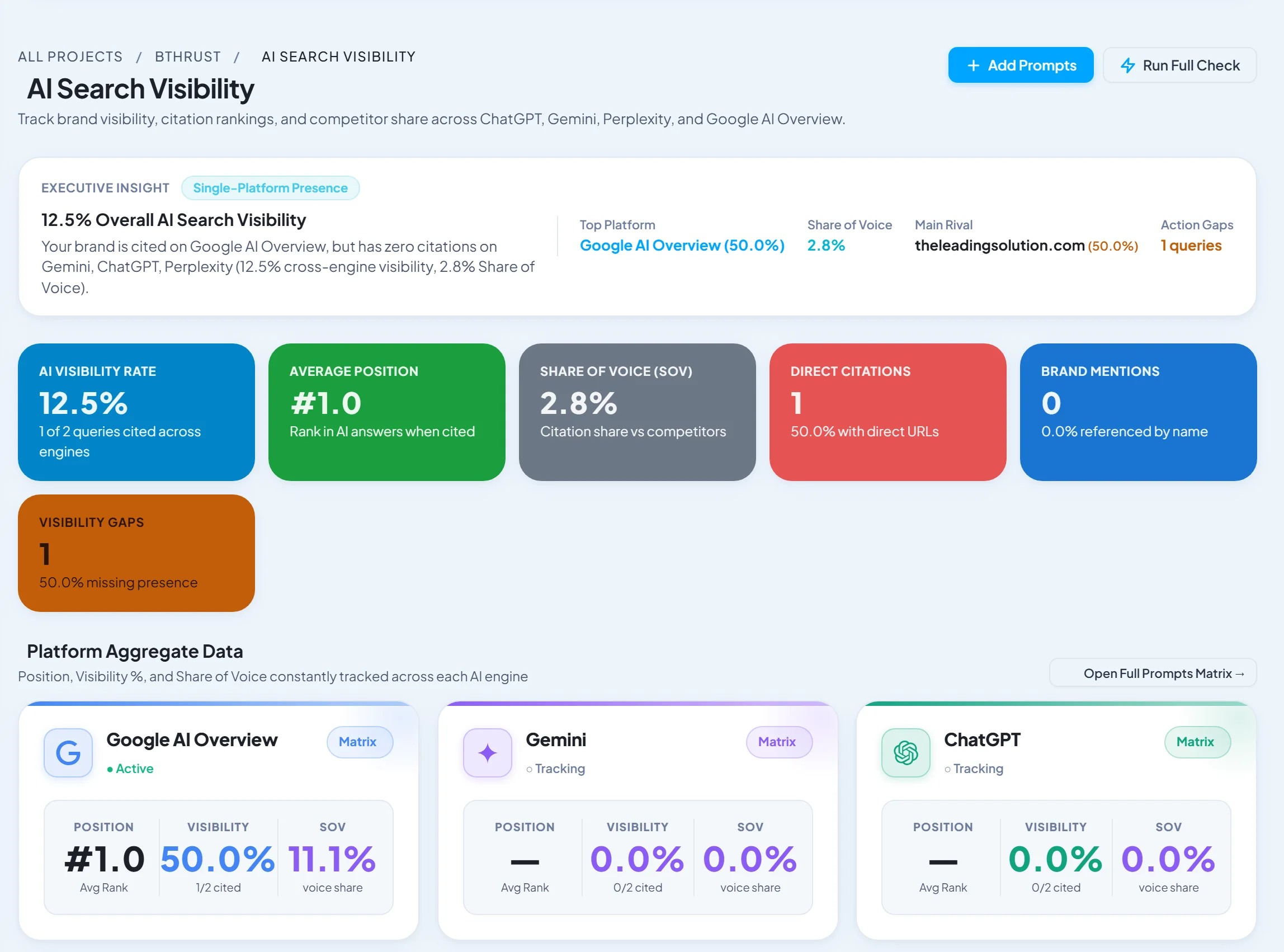


This is one of the clearest architectural explanations of this topic on the web. Sharing this directly with our senior delivery team. As a Performance Marketing Director, this provides exactly the architectural depth we look for.