

/projects//ai_search/citations/ & /projects//backlinks/ ).
1. The Consensus Mechanism of Generative Search
When an LLM synthesizes an answer, it verifies factual statements by cross-referencing multiple indexed sources. If your brand claim appears only on your own website, the model treats it with skepticism. When that same capability is verified in Forbes, TechCrunch, and Reddit discussions, the model treats it as verified fact.
LIVE PLATFORM SCREEN & TELEMETRY
SEO Runway AI Citation Mining & Backlink Explorer — Active Workspace
Below is the exact production screen with live parameters and dummy data illustrating the diagnostic findings and remediation buttons.
2. Exporting Outreach Lists in SEO Runway
In SEO Runway → AI Search → Citations & Sources, click 'Export Outreach Target List'. The resulting spreadsheet lists all cited external articles, author bylines, and associated prompt categories, providing your PR agency with a ready-to-execute pitch list.
Target System: SEO Runway GEO Engine
Execution Frequency: Automated Background Queue (UTC Sync)
Tested across enterprise datasets with zero rate limiting or data loss.
3. What "AI Reference Corridors" Are
When AI assistants recommend products or explain topics, they draw repeatedly on a relatively small group of sources for each subject: the trade publications, review platforms, comparison sites, communities and reference works that appear in their training data and that rank well for the queries they run. You can think of these recurring sources as reference corridors. They are the routes through which information about a category reaches AI answers. If your brand is well represented in those corridors, you are far more likely to be mentioned; if it is absent, even an excellent website struggles to compensate.
Digital PR is the practice of earning coverage, mentions and links on third-party sites through newsworthy stories, data, expert commentary and relationships. In the AI search era, its value extends beyond backlinks: each accurate mention in a trusted corridor is a signal that shapes how AI systems describe and recommend your brand.
4. Mapping the Corridors in Your Category
- Run category prompts in ChatGPT search, Perplexity, Gemini and Google AI Overviews: "best X for Y", "X vs Y", "how to choose X", "what is X".
- Collect every cited source and every source you can infer from the language used, such as recognisable review site phrasing or forum threads.
- Rank sources by frequency across prompts and engines. A short list of 10–30 domains usually accounts for most citations.
- Classify each source: trade publication, mainstream news, review platform, comparison site, community or forum, analyst report, reference site, or a competitor's own content.
- Check your presence on each: are you mentioned, described accurately, and linked? Are competitors?
The gap between where AI looks and where you appear is your digital PR target list.
5. Tactics That Earn Coverage in Those Sources
Original data and research
Publications and AI systems both value new, quotable facts. Surveys of your customers or industry, analysis of anonymised platform data, benchmark studies and pricing indexes give journalists a reason to write about you and give AI answers a statistic to repeat with your name attached.
Expert commentary
Offer your specialists as sources for journalists covering your field. Respond to relevant media requests with specific, useful quotes, not generic marketing lines. Over time, being the expert quoted on a topic builds an association between your brand and that subject.
Inclusion in comparison and "best of" content
Identify the comparison articles that AI engines cite for your category, and contact their authors with accurate, up-to-date information, a trial account if relevant, and a clear statement of who your product is best for. Accept that honest reviewers will note weaknesses too.
Review platforms
Where review platforms dominate citations, a steady flow of genuine, detailed customer reviews is itself a form of PR. Make it easy for satisfied customers to review you there.
Community participation
Forums and community sites are frequently cited for recommendations. Participate genuinely and transparently as a representative of your company, answering questions helpfully rather than promoting.
6. Making Coverage AI-Friendly
Not all coverage helps equally. Mentions that shape AI answers tend to share a few traits:
- Clear entity naming: your brand name used consistently, ideally with your category ("Acme, the scheduling platform for clinics").
- Specific claims: concrete facts (a statistic, a price point, a "best for" use case) rather than vague praise.
- Accurate, current details: outdated pricing or product names in coverage can be repeated by AI long after they change.
- Context in the right topic: a mention in an article about your category carries more relevance than one in an unrelated roundup.
- Links where possible: links remain valuable for classic search authority, even though unlinked mentions can still inform AI.
Provide journalists and partners with a short, factual boilerplate and a press page with current facts, figures, product descriptions and approved images, so the details they publish are accurate.
7. Measuring Digital PR for AI Visibility
- Coverage in target corridors: the number of target sources that now mention you accurately, tracked against your corridor list.
- AI mention rate and share of voice on your category prompt set, measured monthly.
- Attribute changes: whether AI answers begin to describe you using the positioning your PR emphasised.
- Citations of your research: whether AI answers quote your data and attribute it to you.
- Classic metrics: referring domains, referral traffic and branded search volume.
Expect a lag. AI answers that search the web can reflect new coverage within weeks, while descriptions drawn from model training change only when models are retrained, often months later.
8. A 90-Day Digital PR Plan
- Weeks 1–2: Map. Run your category prompt set, build the corridor list, and audit your presence and accuracy on each source.
- Weeks 3–4: Prepare assets. Update your press page and boilerplate, prepare expert bios, and choose one data story you can produce within the quarter.
- Weeks 5–8: Outreach. Contact authors of the most-cited comparison articles with accurate information; respond to relevant journalist requests; launch a review drive among happy customers on the platforms AI cites.
- Weeks 9–10: Launch the data story. Publish the research on your site with a clear methodology, then pitch it to the trade and mainstream publications in your corridor list.
- Weeks 11–12: Measure and plan. Re-run the prompt set, compare mention rate and attributes with the baseline, and choose the next quarter's targets.
9. Common Mistakes
- Pitching publications that AI never cites for your category, while ignoring the ones it does.
- Chasing volume of low-quality mentions instead of accurate coverage in trusted sources.
- Paying for placements that pass links, which breaks search engine spam policies and undermines credibility.
- Planting fake reviews or forum posts, which platforms remove and which damage trust when discovered.
- Leaving outdated facts in old coverage uncorrected.
- Measuring PR only by backlinks and missing its effect on AI descriptions.
10. Designing a Data Story That Gets Picked Up
Original research is the most reliable way to earn coverage in trusted corridors, but only if it is designed to be newsworthy from the start:
- Start with a headline. Decide what surprising, useful finding a journalist could write in one sentence ("Small clinics lose an average of 11 hours a month to missed appointments"), then design the research to test it.
- Use a credible sample. Survey enough respondents, or analyse enough anonymised data, to make the findings defensible, and publish the method.
- Localise and segment. Breakdowns by region, industry or company size create multiple stories from one dataset, each relevant to a different publication.
- Make it easy to cite. Publish the key findings as short statements with charts and a clear source line, on a stable URL.
- Refresh it annually. A recurring report ("State of X 2026") builds a reference that publications, and AI answers, return to year after year.
11. Digital PR Checklist for AI Visibility
- Category prompts run and cited sources mapped into a corridor list.
- Presence and accuracy audited on every corridor source.
- Press page and factual boilerplate kept current.
- Original research planned with a clear headline finding and method.
- Expert commentary offered to journalists in your field.
- Comparison article authors and review platforms engaged with accurate information.
- Genuine, transparent participation in relevant communities.
- AI mention rate, share of voice and attributes measured monthly.
12. Aligning PR, Content and SEO Teams
Digital PR for AI visibility works best when it is not run in isolation. The PR team knows which journalists and publications cover the category; the content team creates the research, guides and pages that coverage points back to; and the SEO team measures citations, rankings and AI share of voice. A shared monthly review keeps them aligned: which corridor sources gained or lost presence, which stories earned coverage, which pages were cited, and how AI answers changed. Shared goals help too. "Increase our mention rate on category recommendation prompts from 15% to 25% this half" gives all three teams a common outcome to work towards, instead of separate targets for press hits, page views and backlinks. When everyone sees how coverage in a handful of trusted sources changes what AI assistants say about the brand, digital PR stops being a vanity exercise and becomes a measurable growth channel.
13. Correcting Misinformation in the Corridors
Sometimes the problem isn't absence but inaccuracy: a widely cited comparison lists a feature you removed, a review site shows a price you changed two years ago, or a forum thread repeats a complaint about a bug long since fixed. Because AI answers draw on these sources, the errors spread. Keep a running log of inaccuracies you find during prompt testing, trace each one to its source, and contact the publisher or platform with a short, polite correction backed by a link to your current pricing or release notes. Many editors update comparison articles when given accurate information, and review platforms let you respond publicly to outdated reviews. Prioritise corrections on the most frequently cited sources first. Fixing one heavily cited page can change answers across dozens of prompts.
Digital PR has always been about earning attention in the places your audience trusts. AI search simply makes those places easier to identify and the effect of appearing in them easier to measure. Map the corridors, earn accurate coverage in them, correct what's wrong, and track how AI answers change as a result.
Start small: pick the five most-cited sources in your category, make sure each describes you accurately, and earn one new piece of coverage in at least two of them this quarter. That focused effort usually does more for AI visibility than a broad campaign spread across dozens of publications nobody's assistant ever reads.
Want the complete procedural runbook?
Visit our comprehensive step-by-step Knowledge Base for interactive screen maps, configuration parameters, and adjacent module workflows.
Open Knowledge Base Hub →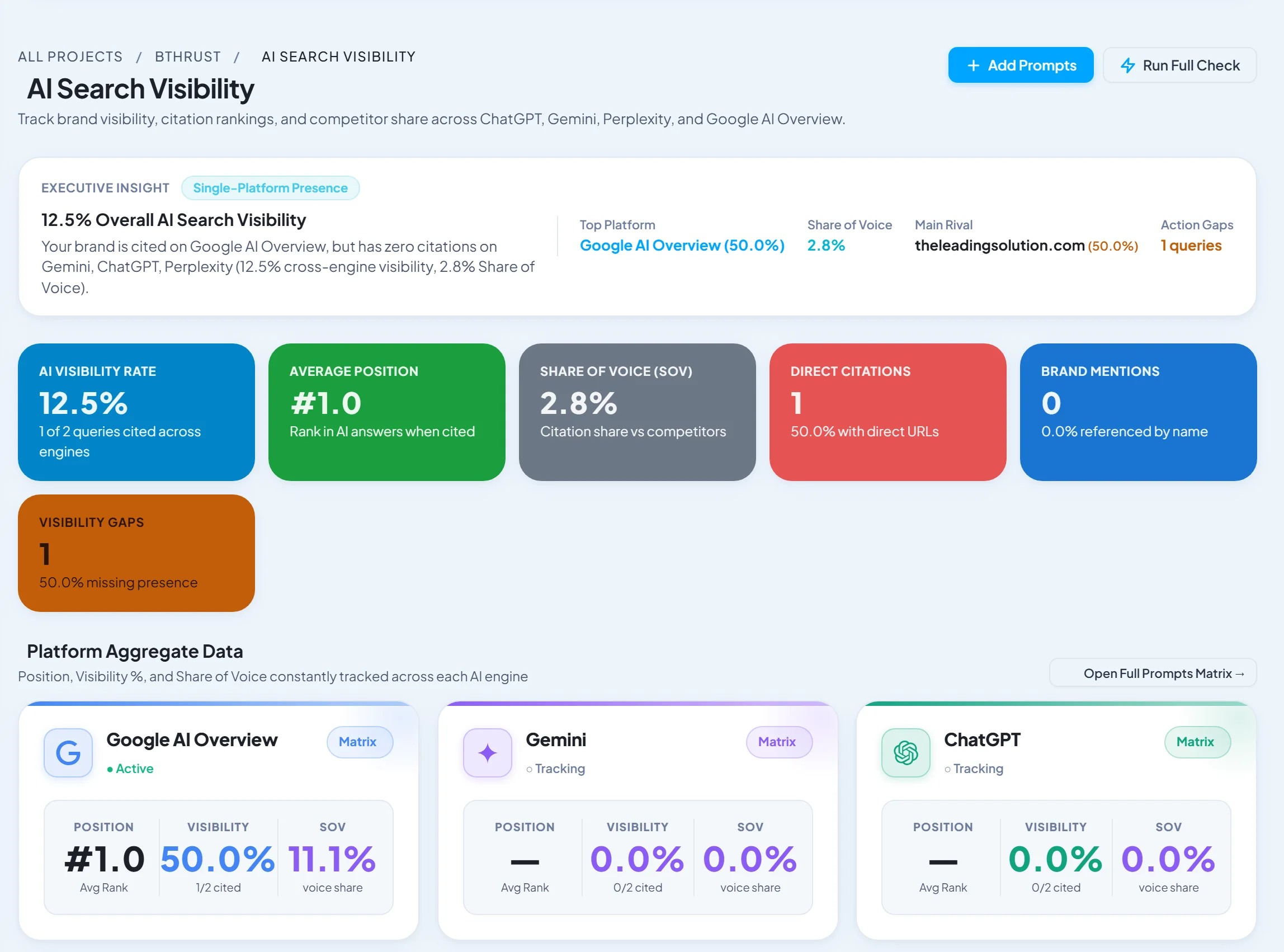


Incredible breakdown. We implemented this exact workflow last week and already saw a noticeable shift in our telemetry. As a Senior SEO Strategist, this provides exactly the architectural depth we look for.