

/projects//ai_search/ & /projects//content/ ).
1. Anatomy of a Multi-Turn B2B Buyer Dialogue
Consider a prospect searching in ChatGPT: Turn 1: 'What are the top enterprise uptime monitoring tools?' → Turn 2: 'Which of these support automated RDAP domain tracking?' → Turn 3: 'What is the pricing difference between Tool A and Tool B?' If your documentation hides pricing or feature specifics, the AI will drop your brand on Turn 2 or 3.
LIVE PLATFORM SCREEN & TELEMETRY
SEO Runway AI Search Prompts & Content Studio — Active Workspace
Below is the exact production screen with live parameters and dummy data illustrating the diagnostic findings and remediation buttons.
2. Designing Turn-Resilient Content
Use SEO Runway → Content Studio to embed comprehensive objection-handling FAQs and transparent technical specifications with JSON-LD FAQPage markup.
Target System: SEO Runway GEO Engine
Execution Frequency: Automated Background Queue (UTC Sync)
Tested across enterprise datasets with zero rate limiting or data loss.
3. How Multi-Turn Search Differs from a Single Query
In traditional search, each query stands alone. In conversational search, users refine their needs over several turns: "What's a good CRM for a small agency?" is followed by "Which of those integrate with Google Workspace?", then "Which is cheapest for five users?", then "Is HubSpot's free plan enough?". Each follow-up narrows the field and carries context from earlier turns. A brand that appears in the first answer but has no clear information about integrations or per-user pricing can drop out at the second or third turn.
Optimising for multi-turn search therefore means making sure your content answers not just the opening question but the predictable follow-ups, so you stay in the conversation as it narrows towards a decision.
4. Mapping Conversation Paths
- Start with opening prompts: the broad questions that begin research in your category.
- List natural follow-ups by asking, for each opening answer, "What would a buyer ask next?" Typical follow-ups narrow by price, size, integrations, features, location, compliance, support and alternatives.
- Test real conversations in ChatGPT, Gemini and Perplexity: ask the opening prompt, then each follow-up in the same chat, and record which brands remain at each turn.
- Find your drop-off points: the turn at which your brand disappears, and the attribute that caused it (no pricing information, no stated integration, no evidence for a use case).
- Repeat with personas, such as a freelancer, a 50-person agency or an enterprise buyer, since paths diverge by context.
5. Content That Survives the Narrowing
State the attributes that filter choices
Follow-up questions usually filter by concrete attributes. Publish them plainly: pricing by tier and seat count, supported integrations, platform availability, data residency, compliance certifications, support hours, contract terms and minimums. If an assistant can't find the attribute, it can't confirm you meet the requirement, so you are dropped.
Build pages around follow-up questions
Create focused pages or sections for common narrowing questions: "[Product] pricing for small teams", "[Product] integrations", "[Product] for agencies", "[Product] vs [Competitor]". Each gives retrieval systems a direct match for the follow-up.
Write self-contained answers
Each section should restate its subject so it makes sense out of context ("Acme's Starter plan costs $29 per user per month and includes..."). Passages that depend on earlier paragraphs ("this plan includes...") are harder for an assistant to use when it retrieves just that section for a follow-up.
Cover comparisons honestly
Many conversations end with "Which should I choose between X and Y?". Fair comparison pages that state where each option is stronger give assistants material to draw on and make your brand part of the final decision.
6. Structuring Information for Context Carry-Over
- Consistent naming: use the same product and plan names everywhere, so an assistant can connect facts from different pages to the same entity across turns.
- Clear hierarchy: product → plans → features → limits, reflected in headings and URLs, helps systems understand relationships when answering "Does the cheaper plan include that?".
- Comparison tables for plans and competitors, which answer several narrowing questions at once.
- FAQ sections on key pages that cover typical follow-ups in question-and-answer form.
- Structured data for products, offers and organisations, so key facts are also available in machine-readable form.
7. Measuring Multi-Turn Visibility
Single-prompt tracking misses drop-offs. Add a few scripted conversations to your AI visibility monitoring:
- Survival rate: the share of scripted conversations in which your brand is still mentioned at the final turn.
- Drop-off turn: where you most often disappear, and why.
- Final recommendation share: how often you are the recommended choice at the end.
- Attribute accuracy: whether the assistant states your pricing, integrations and limits correctly.
Run the same conversations monthly. Improvements in survival rate after you publish missing attribute information are among the clearest signals that the work is paying off.
8. Common Mistakes
- Hiding pricing behind "contact sales" with no indication of ranges or plan structure, which removes you from budget-filtered conversations.
- Describing integrations only in logos or images, without text an assistant can read.
- Different plan names on the website, in documentation and on review sites.
- Long pages where key facts are buried in paragraphs referring to "it" and "this".
- Testing only opening prompts and never following the conversation through.
9. A Worked Conversation
Consider a scripted test for a fictional email marketing tool, "Postline":
- Turn 1: "What are good email marketing tools for a small online shop?" Postline is listed fourth of six.
- Turn 2: "Which of those integrate with Shopify?" Postline drops out. Its Shopify integration exists, but it is only shown as a logo on the integrations page, with no text description.
- Turn 3: "Which is cheapest for 5,000 subscribers?" The remaining tools are compared on published pricing.
The fix is straightforward: add a dedicated "Postline + Shopify" page describing the integration in text (what syncs, setup steps, which plans include it), add Shopify to the integrations list as text, and publish pricing by subscriber count in a table. Re-running the same conversation a few weeks later shows whether Postline now survives turn two and appears in the price comparison at turn three.
10. Multi-Turn Optimisation Checklist
- Opening prompts and their natural follow-ups mapped for each persona.
- Scripted conversations tested in each major assistant.
- Drop-off points and missing attributes identified.
- Pricing, integrations, limits and compliance stated in plain text.
- Focused pages for common follow-up questions.
- Self-contained passages that name their subject.
- Consistent product and plan naming across all sources.
- Survival rate and final recommendation share tracked monthly.
11. Third-Party Sources in Multi-Turn Answers
As conversations narrow, assistants often turn to third-party sources for confirmation: review sites for "Which has the best support?", community threads for "Do people actually like X?", and comparison articles for "X vs Y". Your own pages may answer the factual follow-ups, but these evaluative follow-ups depend on what others say about you. Check which sources appear at the later turns of your scripted conversations, make sure your profiles there are complete and accurate, and encourage satisfied customers to share specific experiences. Detailed reviews that mention attributes ("setup took an afternoon", "support replied within an hour") are especially useful, because they match the evaluative questions buyers ask late in a conversation.
12. Supporting Sales Conversations Too
The follow-up questions buyers ask AI assistants are often the same questions they ask your sales team. Share your conversation maps with sales and customer success. The drop-off attributes you discover (unclear pricing, missing integrations, unanswered compliance questions) are usually friction points in human sales conversations as well. Fixing them on your website helps AI visibility and shortens sales cycles at the same time, which makes the work easier to justify.
13. Prioritising Which Follow-Ups to Address
You can't create content for every possible follow-up, so focus where the business impact is highest. Score each common follow-up on three factors: how often it appears in your scripted conversations and sales notes, how often it causes your brand to drop out, and how valuable the buyers asking it are. A follow-up like "Which supports SSO?" might be rare overall but decisive for enterprise buyers, while "Which has a free trial?" might be common across every segment. Address the high-frequency, high-drop-off and high-value questions first, usually pricing, integrations and fit for specific team sizes. Then work down the list, re-testing conversations after each batch of changes so you can see which content actually keeps you in the answer through the final turn.
14. Designing Content Hubs for Conversations
A useful way to organise content for multi-turn search is a hub per buying decision. The hub page answers the opening question ("Choosing an email marketing tool for an online shop") and links to focused pages for each predictable follow-up: integrations with the major e-commerce platforms, pricing at different list sizes, deliverability, automation features, migration from competitors, and comparisons with the most common alternatives. Each focused page opens with a direct answer and restates the product name and context, so it works on its own when an assistant retrieves it for a single follow-up.
Internal links between the hub and its pages, with descriptive anchors, help search engines and AI retrieval systems understand that these pages belong together. They also mirror how a human buyer moves through the decision. That alignment between content structure and conversation structure is what keeps a brand present from the first broad question to the final "which should I choose?".
15. Voice and Mobile Conversations
Multi-turn search increasingly happens by voice and on mobile, where answers are shorter and users rarely see more than one or two options. In these contexts, being the clearest match for the narrowed need matters even more. Concise, unambiguous statements of the attributes that buyers filter on, such as price, location, availability and compatibility, give assistants the confidence to name you in a short spoken answer, where there is no room for a long list of alternatives.
Conversational search rewards brands that answer the second, third and fourth questions as clearly as the first. Map the conversations your buyers actually have, publish the facts that filter choices in plain, self-contained language, and test the full path every month. Each drop-off you fix keeps your brand in the conversation a little longer, and the brands still present at the final turn are the ones that win the decision. Start with the three conversations that matter most to your revenue, and expand from there once you see which fixes keep you in the answer.
Keep your conversation maps in a shared document so content, product marketing and sales can all add new follow-up questions as they hear them from real buyers.
Want the complete procedural runbook?
Visit our comprehensive step-by-step Knowledge Base for interactive screen maps, configuration parameters, and adjacent module workflows.
Open Knowledge Base Hub →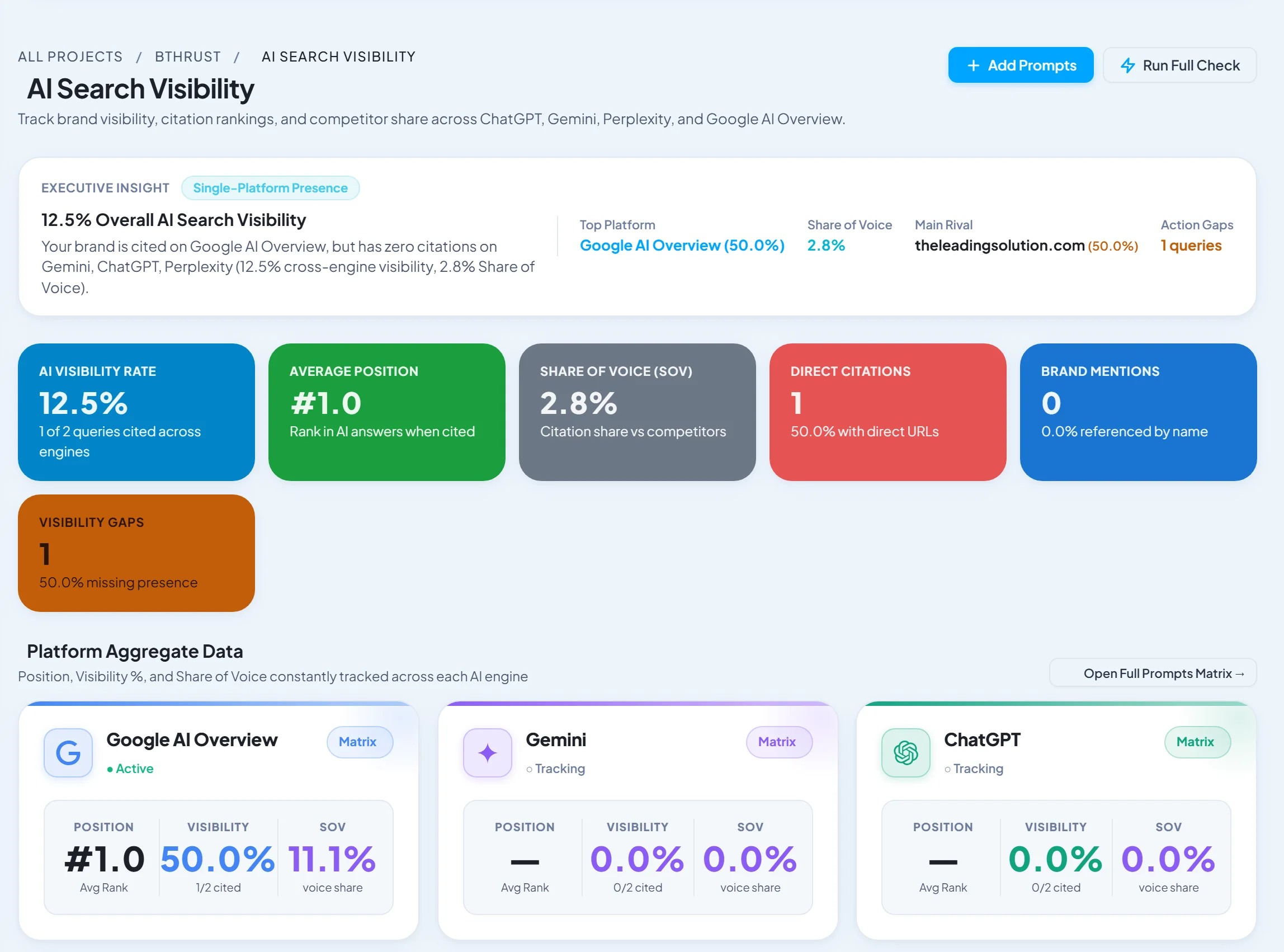


Bookmarked. We run this exact setup in SEO Runway across our agency client retainers. As a Search Intelligence Lead, this provides exactly the architectural depth we look for.