

/projects//ai_search/readiness/ ).
1. Why LLMs Hallucinate Obsolete Pricing Data
Large language models synthesize information from historical web crawls and third-party review sites that may be 3 to 5 years old. If an old blog post mentions a discontinued $29 plan, ChatGPT may quote that price alongside modern enterprise features, setting incorrect buyer expectations.
LIVE PLATFORM SCREEN & TELEMETRY
SEO Runway AI Search Readiness & Structured Data Validator — Active Workspace
Below is the exact production screen with live parameters and dummy data illustrating the diagnostic findings and remediation buttons.
2. Enforcing Pricing Clarity with SEO Runway
Verify your pricing page schema in SEO Runway → Site Audit → Structured Data. Ensure that price, priceCurrency, and priceValidUntil are declared accurately across all public pricing tiers.
Target System: SEO Runway GEO Engine
Execution Frequency: Automated Background Queue (UTC Sync)
Tested across enterprise datasets with zero rate limiting or data loss.
3. Why AI Assistants Get Your Facts Wrong
When an AI assistant states that your product costs $99 a month when it actually costs $49, or claims you offer a feature you discontinued, it isn't lying. It is generating text from patterns in its training data and from whatever pages it retrieves. Errors about pricing and features usually come from a few predictable sources:
- Outdated training data: the model learned your pricing from pages written before your last price change.
- Stale third-party pages: comparison articles, review sites and directories still list old plans or features.
- Ambiguous or missing official information: if your site doesn't state a price clearly, the model fills the gap from elsewhere, or guesses.
- Inconsistent naming: different plan names on your site, in documentation and in reviews make it hard to connect facts correctly.
- Confusion with similarly named products, which blends another company's details into answers about yours.
The impact is real: buyers who are told your product is more expensive than it is, or lacks a feature it has, may never visit your site to find out otherwise.
4. Auditing What AI Says About You
- Build a fact sheet of the claims that matter most: current plan names and prices, key features by plan, limits, free trial or free plan terms, supported platforms and integrations, company location and founding facts.
- Write test prompts that ask for each fact directly ("How much does Acme cost?", "Does Acme have a free plan?", "Does Acme integrate with Salesforce?") and indirectly ("Is Acme good for a 10-person team on a budget?").
- Run the prompts in ChatGPT (with and without search), Gemini, Perplexity and Google AI Overviews, several times each.
- Record every error: the wrong claim, the engine, and any source shown.
- Trace the sources: for search-enabled answers, follow the citations; for others, search the web for the exact wrong claim to find where it is still published.
5. Fixing the Information at the Source
Make your official facts unmissable
- Publish pricing in plain HTML text on a dedicated pricing page, with plan names, prices, billing periods and currency clearly stated.
- Add a "last updated" date to pricing and feature pages.
- Use a plan comparison table showing which features each plan includes.
- Write a short, factual summary at the top of the pricing page ("Acme has three plans: Starter at $29, Pro at $79 and Business at $199 per month, billed monthly").
- Add Product or SoftwareApplication structured data with offers that match the visible prices exactly.
Correct third-party sources
Contact the publishers of outdated comparison articles with the correct information, update your profiles on review platforms and directories, and respond to outdated reviews publicly with the current facts. Prioritise the sources most often cited or reflected in wrong answers.
Announce changes clearly
When you change pricing or retire a feature, publish a dated announcement or changelog entry, so there is an authoritative, crawlable record of the change.
6. Technical Steps That Help
- Allow AI search crawlers (such as OAI-SearchBot and PerplexityBot) to access your pricing and product pages, so search-enabled answers retrieve the current versions.
- Keep key facts in server-rendered HTML. Pricing rendered by a JavaScript widget, or shown only after a currency or plan selector is clicked, may not be read.
- Avoid images of text for prices and feature lists.
- Use consistent canonical URLs for pricing and feature pages, and redirect old pricing pages to the current one.
- Remove or update old pages that still state outdated prices, such as old blog announcements, landing pages for retired plans and PDF datasheets.
- Consider an llms.txt file that points AI tools to your authoritative pricing and product pages. It is low-cost, though its effect is unproven.
7. Using Feedback Channels
Several AI products let users flag inaccurate answers. Where a clear factual error persists, use the feedback option on the answer, with a short correction. This won't fix errors on its own, but it adds to the signals providers use to improve accuracy. The lasting fix is still changing the information the model learns from and retrieves.
8. Monitoring Over Time
Re-run your fact-check prompts monthly and after every pricing or product change. Track an "accuracy rate": the share of test answers that state each key fact correctly. Search-enabled answers usually improve within weeks once official and third-party pages are corrected. Answers drawn purely from model knowledge improve more slowly, often only when providers release updated models. Keep your correction log, and you'll be able to see which fixes made the difference.
9. Prevention Checklist
- A maintained fact sheet of pricing, plans, features and company facts.
- Pricing and features in plain HTML with dates and a comparison table.
- Structured data matching visible prices exactly.
- Consistent plan and product names across every channel.
- Outdated pages removed, updated or redirected.
- Third-party sources corrected, starting with the most cited.
- Dated announcements for every pricing or feature change.
- Monthly fact-check prompts across major assistants, with an accuracy rate tracked.
10. A Worked Example
A project management SaaS changed its pricing from per-workspace to per-user a year ago. In fact-check testing, AI answers still described the old model about half the time and quoted a retired "Team" plan. Tracing the sources revealed four culprits: an old pricing announcement on the company blog, a PDF datasheet linked from the footer, two widely cited comparison articles, and the company's own profile on a major review platform, which had never been updated.
The fix took two weeks. The old blog post gained a prominent note linking to current pricing, the PDF was replaced and the old URL redirected, both comparison authors were sent updated information (one updated within a week), and the review profile was corrected. The pricing page also gained a one-sentence summary and a plan comparison table. In the next month's test, search-enabled answers described per-user pricing correctly in most runs. Answers without search improved more slowly, which is consistent with their reliance on older training data.
11. Handling Pricing That Varies
If your pricing varies by region, currency, contract length or usage, errors are more likely, because assistants simplify. Help them with explicit statements such as "Prices shown are in USD for monthly billing; annual billing saves 20%; prices in GBP and EUR are listed on regional pricing pages". If you have usage-based pricing, publish worked examples ("A team of 10 sending 50,000 emails a month pays about $X"). For enterprise pricing that isn't public, say so clearly ("Enterprise pricing is quoted on request, typically for teams over 200 users") rather than leaving a gap that assistants fill with guesses.
12. Who Should Own This
AI accuracy sits between marketing, product and SEO, so it often belongs to nobody. Assign a clear owner, usually product marketing or the SEO lead, and give them a simple process: maintain the fact sheet, run the monthly prompt checks, log errors and their sources, coordinate corrections with whoever owns each source, and report the accuracy rate. Add a step to every pricing or product launch checklist: "Update pricing page, structured data, review profiles, partner listings and the fact sheet; schedule an AI accuracy check two weeks after launch." Built into the launch process, accuracy becomes routine rather than a crisis discovered when a prospect quotes the wrong price back to your sales team.
13. Common Mistakes
- Assuming the model will "catch up" on its own while outdated pages remain live across the web.
- Fixing only your website and ignoring the review sites and comparison articles that assistants cite.
- Hiding prices completely, which invites guesses and outdated figures to fill the gap.
- Using different plan names in marketing, billing and documentation.
- Testing once after a price change instead of tracking accuracy monthly.
- Leaving old PDFs and landing pages indexed with retired prices.
Accurate AI answers about your business aren't something you can control directly, but you can make the correct facts far easier to find than the wrong ones. Consistent, current, plainly stated information on your own site, reinforced by accurate third-party sources, is the most reliable way to stop errors spreading and to correct the ones already out there.
14. Feature Claims Need the Same Care as Prices
Pricing errors get the most attention, but feature errors are just as damaging. An assistant that says you lack an integration, a compliance certification or a key capability can remove you from a buyer's shortlist instantly. Apply the same discipline to features: keep a public, text-based feature list or comparison table by plan, describe each major integration on its own page or section, and publish compliance information (such as SOC 2 or GDPR commitments) clearly on a security or trust page. When you launch a feature, describe it in a dated release note and update the comparison table the same day. When you retire one, say so explicitly rather than quietly removing it, so there is a clear, current record that assistants and third-party writers can rely on. Include feature questions in your monthly fact-check prompts, especially for the capabilities buyers most often use to filter options.
Treat AI accuracy as part of brand management. A short monthly check, a maintained fact sheet and a habit of correcting sources quickly will prevent most pricing and feature errors before they cost you deals. The effort is small compared with the cost of prospects ruling you out based on a price or feature that was never true, or stopped being true long ago.
Share the monthly accuracy rate with sales and support, too. They hear the consequences of AI errors first, and they can tell you which wrong claims prospects repeat most often.
Want the complete procedural runbook?
Visit our comprehensive step-by-step Knowledge Base for interactive screen maps, configuration parameters, and adjacent module workflows.
Open Knowledge Base Hub →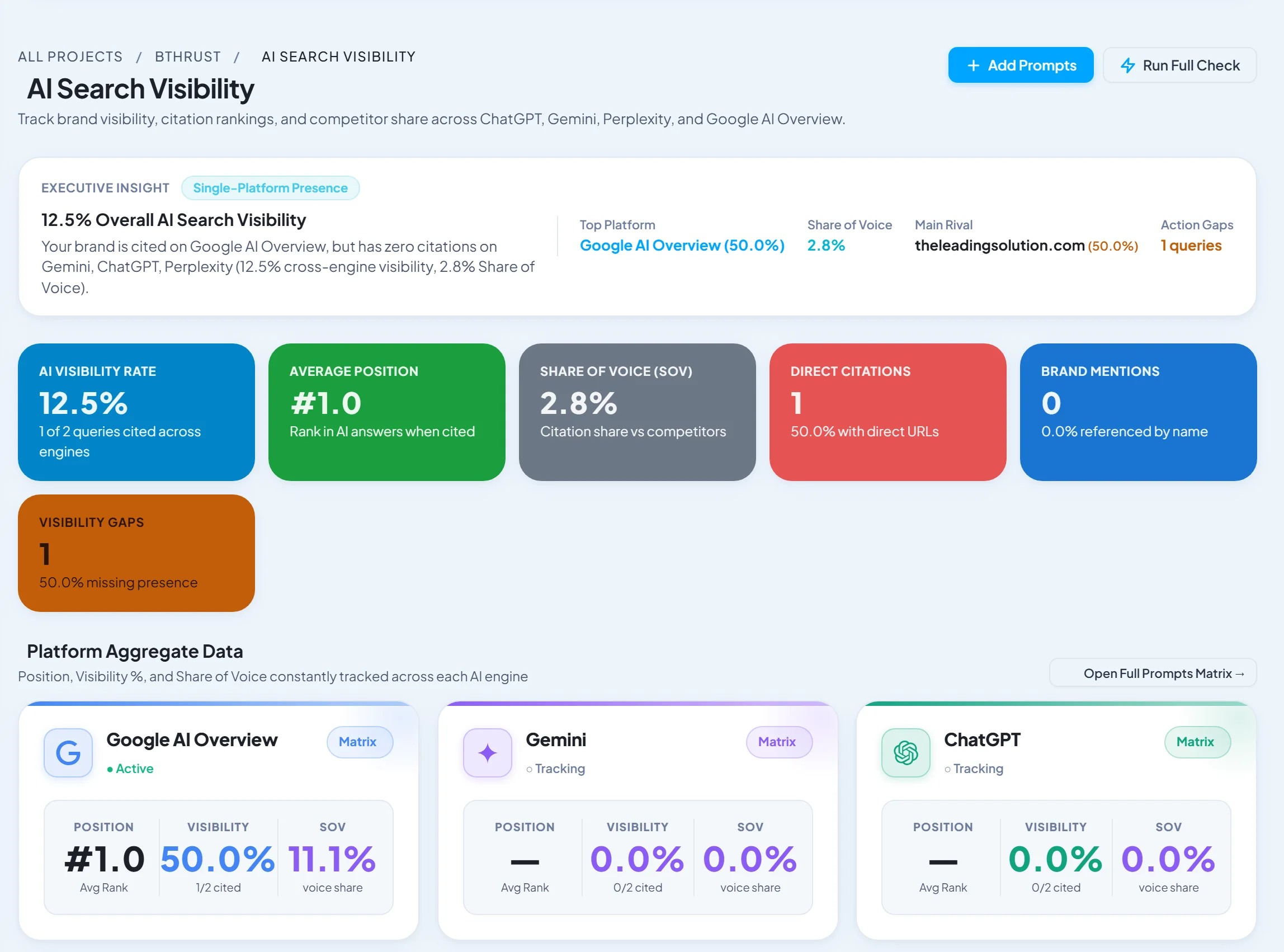


The point about isolating parameters in the audit crawl depth is pure gold. Saved our engineering team dozens of hours. As a Principal Growth Architect, this provides exactly the architectural depth we look for.