

/projects//ai_search/citations/ & /projects//ai_search/prompts/ ).
1. Retrieval-Augmented Generation (RAG) Architecture Unpacked
Conversational search engines combine real-time web retrieval with large language models. When a user enters a complex prompt (e.g., 'What are the top enterprise SEO platforms for multinational e-commerce?'), the engine performs synthetic sub-queries, scrapes the top 10 search results, converts the text into vector embeddings, and extracts relevant passages to synthesize the response.
LIVE PLATFORM SCREEN & TELEMETRY
SEO Runway AI Search (GEO) Citation Mining & Engines — Active Workspace
Below is the exact production screen with live parameters and dummy data illustrating the diagnostic findings and remediation buttons.
2. Citation Mining Workflow with SEO Runway
- Open Screen (AI Search (GEO) → Prompts):
- Review the Top Cited Domains Leaderboard for your tracked prompt library.
- Filter by 'Competitor Cited, Brand Missing' to reveal third-party publications and directories that directly feed AI answers.
- Use the resulting list to direct your digital PR, guest contribution, and review acquisition efforts toward high-weighting citation sources.
3. Structuring Content for Instant Vector Extraction
LLM extractors favor distinct data tables, definition blocks (<dl>, <dt>), and bulleted procedural steps. Avoid burying key metrics inside lengthy narrative paragraphs.
Target System: SEO Runway GEO Engine
Execution Frequency: Automated Background Queue (UTC Sync)
Tested across enterprise datasets with zero rate limiting or data loss.
4. How AI Search Engines Choose Their Sources
ChatGPT search, Perplexity and similar answer engines work differently from a traditional results page. When a user asks a question, the system rewrites it into one or more search queries, retrieves candidate pages from a web index (its own, a partner's, or both), reads the most promising pages, and generates an answer that cites some of them. Understanding each step tells you where you can influence the outcome:
- Query rewriting: the engine turns a conversational prompt into search-style queries. Pages that match those underlying queries are retrieved; pages that only match the exact wording of the prompt may not be.
- Retrieval: pages must be crawlable by the engine's crawler (for example OAI-SearchBot for ChatGPT search, PerplexityBot for Perplexity) and rank reasonably well in the index it queries.
- Reading and extraction: the model reads the retrieved pages and extracts passages that answer the question. Clear, self-contained passages are easier to use.
- Citation: the engine attributes claims to the sources it relied on. Pages providing unique facts, definitions, data or clear recommendations are more likely to be cited than pages repeating common knowledge.
5. Reverse-Engineering the Citations You See
You can learn a great deal by systematically studying who gets cited for the questions you care about:
- Build a prompt set. List 30–50 questions your customers ask at every stage: problem awareness, comparisons, "best" queries, pricing, and how-to questions.
- Run each prompt in each engine, in fresh sessions, several times. Answers vary between runs, so you need repeats to see patterns.
- Record every citation: the URL, the domain, the type of page (guide, listicle, forum thread, review site, documentation, news) and the passage the engine seems to have drawn from.
- Aggregate by domain and page type. Count how often each domain is cited across all prompts. A small set of domains usually dominates.
- Compare the cited pages with yours. Look at their structure, freshness, depth, use of data, headings and how directly they answer the question.
6. Patterns That Commonly Earn Citations
- A direct answer near the top of the page, in one or two sentences, before the detail.
- Specific, verifiable facts: numbers, dates, prices, specifications, step counts. Answer engines prefer passages they can quote with confidence.
- Clear structure: descriptive headings phrased like questions, short paragraphs, lists and tables that isolate each idea.
- Comparison and "best" content for commercial questions. Engines often cite listicles and comparison pages when users ask for recommendations.
- Freshness: recently updated pages with visible "last updated" dates tend to be favoured for fast-changing topics.
- Original information: first-party data, research, case studies and expert commentary that can't be found elsewhere.
- Third-party presence: for brand recommendations, engines frequently cite review sites, forums such as Reddit, and industry publications rather than brands' own pages.
7. Turning Insights into Page Changes
- Answer first. Rewrite the opening of each target page so the first paragraph answers the core question plainly. Keep the context and nuance below it.
- Make passages self-contained. Each section should make sense if it is the only part of the page an engine reads. Avoid "as mentioned above" references in key passages.
- Add the facts engines look for. If cited competitors include prices, timelines or specifications and you don't, add accurate versions with dates.
- Use question-style headings that match how people ask, such as "How long does a domain transfer take?", followed by the answer.
- Add comparison tables where users compare options. Tables are easy to extract and frequently reflected in AI answers.
- Show expertise. Name authors with relevant experience, cite sources, and include first-hand testing notes or examples.
- Keep pages updated and show the date. Set a refresh schedule for pages targeting fast-changing questions.
8. Technical Requirements
- Allow the right crawlers. Check robots.txt allows OAI-SearchBot and PerplexityBot if you want to appear in those engines' answers. Blocking training crawlers such as GPTBot is a separate decision and doesn't stop search citations.
- Render content in HTML. AI crawlers vary in their ability to execute JavaScript. Content present in the initial HTML is the safest.
- Be fast and reliable. Answer engines fetch pages in real time for some queries; slow or failing pages are skipped.
- Rank in classic search. Many AI search systems retrieve from web search indexes. Pages that rank on page one for the underlying queries are far more likely to be retrieved and cited.
9. Building Presence Beyond Your Own Site
For commercial "best" and "which should I choose" questions, engines often cite third-party sources. If your audit shows forums, review platforms or industry publications dominate citations, your own site alone won't win those answers. Earn mentions on those sources: participate genuinely in relevant community discussions, encourage reviews on the platforms engines cite, pitch data and expert commentary to the publications that appear most often, and make sure you're included in reputable comparison articles. Every cited third-party page that mentions you increases the chance you appear in the generated answer, even when your own site isn't the one linked.
10. Measuring Progress
Re-run the same prompt set on a fixed schedule, weekly or monthly, and track:
- Citation rate: the share of prompts where your domain is cited, per engine.
- Mention rate: the share where your brand is named, linked or not.
- Share of voice: your mentions compared with your main competitors across the prompt set.
- Cited URLs: which of your pages are cited, to see which changes worked.
- Referral traffic: sessions from chatgpt.com, perplexity.ai and similar referrers in analytics.
Because answers vary from run to run, judge trends across the whole prompt set over several weeks, not individual answers. An AI visibility tracker that runs your prompts on a schedule and separates mentions from citations makes this practical at scale.
11. Differences Between Engines
Each engine has its own habits, so analyse them separately. Perplexity shows its sources prominently and tends to cite many pages per answer, which makes it easier to earn a citation with a clear, factual page. ChatGPT search typically cites fewer sources and often blends its own knowledge with retrieved pages, so brand presence across the wider web matters more. Google AI Overviews draw heavily on pages that already rank in Google's results. A strategy that works in one engine usually helps in the others, but the citation patterns, and therefore the quickest wins, differ.
12. Common Mistakes
- Testing a prompt once and drawing conclusions from a single answer.
- Blocking AI search crawlers while expecting AI citations.
- Rewriting pages into keyword-stuffed Q&A blocks that read poorly for humans.
- Ignoring third-party sources that engines cite for recommendation queries.
- Publishing claims without dates or sources, which engines and users trust less.
13. A Worked Example
Imagine a payroll software company asking why it never appears when users ask Perplexity "What's the best payroll software for a 20-person company?". A citation audit across 40 related prompts might show three patterns. Most citations go to two comparison sites and a handful of Reddit threads. The company's own pricing page is cited only for "how much does [brand] cost" prompts. And competitors that appear in answers have comparison pages with tables showing pricing per employee, while the company has none.
The response follows from the evidence: publish an honest comparison page with a pricing table and clear "best for" guidance, add a plain-English answer to the top of the pricing page, pitch updated pricing data to the comparison sites that dominate citations, and contribute genuinely helpful answers in the relevant community threads. Re-running the prompt set monthly shows whether citations and mentions rise, and which changes drove them.
14. Citation Audit Checklist
- 30–50 customer prompts covering every buying stage.
- Each prompt run several times per engine in fresh sessions.
- Every citation recorded with domain, page type and passage.
- Top cited domains and page types identified.
- Target pages rewritten with answer-first openings, facts and clear structure.
- AI search crawlers allowed; content present in HTML.
- Presence built on the third-party sources engines cite.
- Prompt set re-run on a schedule to track citations and mentions.
15. Keeping the Audit Fair and Repeatable
AI answers are influenced by location, account history and conversation context, so control what you can. Use logged-out or fresh sessions where possible, keep the same location settings, ask each prompt in a new conversation rather than as a follow-up, and record the date and engine version for each run. Store results in a simple spreadsheet or tracking tool so the next audit compares like with like. Consistent methods are what turn a handful of interesting screenshots into reliable evidence about whether your citation rate is actually improving.
Share the results with content, PR and product teams. Each group can act on different findings, from page rewrites to outreach targets to correcting product facts.
Want the complete procedural runbook?
Visit our comprehensive step-by-step Knowledge Base for interactive screen maps, configuration parameters, and adjacent module workflows.
Open Knowledge Base Hub →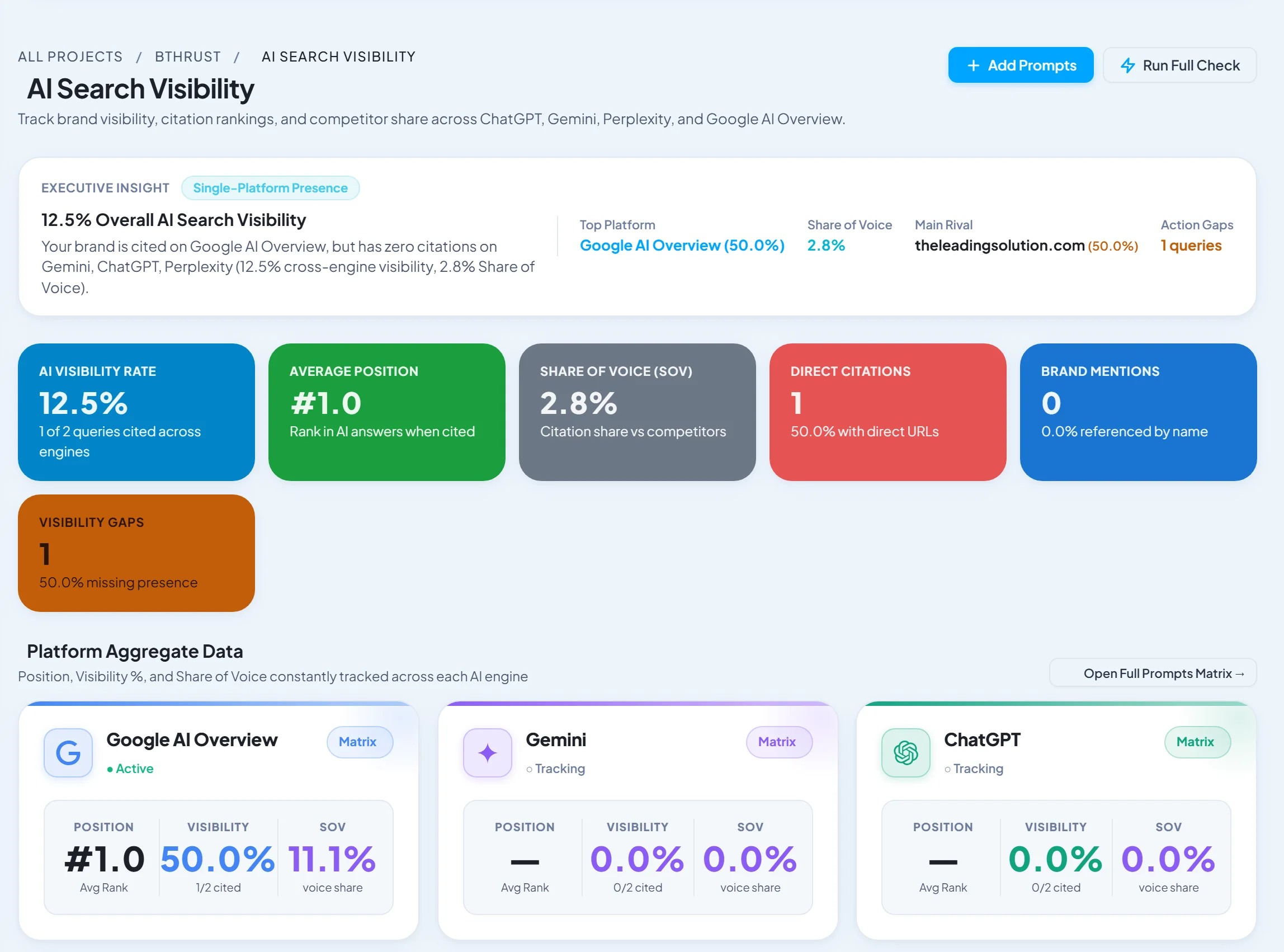


This is one of the clearest architectural explanations of this topic on the web. Sharing this directly with our senior delivery team. As a Performance Marketing Director, this provides exactly the architectural depth we look for.