Short answer: Optmyzr is the most powerful negative keyword tool, with n-gram analysis and automation. SEO Runway is the simplest way for businesses and agencies running Ads beside SEO to mine search terms, spot wasted spend and get negative suggestions. Negator.io and Karooya are focused, affordable specialists. Small accounts can start free with Google's search terms report.
Disclosure: SEO Runway is our product. We ranked it using the same criteria as every other tool, and noted where others do better.
Quick picks
- Most powerful: Optmyzr
- Simplest, next to SEO: SEO Runway
- Best specialist: Negator.io
- Best for waste reports: Karooya
- Free: Google Ads search terms report
Negative keyword tools compared
| Tool | Search-term mining | N-grams | Automation | Shared lists | Savings report | From |
|---|---|---|---|---|---|---|
| Optmyzr | Yes | Yes | Rules | Yes | Yes | ~$209* |
| SEO Runway | Yes | Check | Suggestions | Check | Wasted spend flagged | $29 |
| Adalysis | Yes | Yes | Yes | Yes | Partial | ~$149* |
| Negator.io | Yes | Partial | Rules | Yes | Yes | See site* |
| Karooya | Yes | Yes | Partial | Yes | Yes | See site* |
| Opteo | Yes | Partial | Recommendations | Yes | Yes | ~$129* |
| Adzooma | Yes | No | Rules | Check | Partial | Free plan* |
| WordStream | Yes | No | Workflow | Check | Partial | See site* |
| Semrush | Research | No | No | No | No | ~$139* |
| Google Ads (native) | Search terms report | No | No | Yes | No | Free |
*Approximate; verify.
How we chose these tools
We compared each tool's published features, plans and documentation on six criteria: search-term mining, n-gram analysis (finding wasteful words across many queries), automation, shared negative lists, savings reporting, and price.
1. Optmyzr: most powerful
Verdict: n-gram analysis across accounts plus rules to automate negatives.
Pros: depth; automation.
Cons: price; a learning curve.
2. SEO Runway: simplest, next to SEO
Verdict: search-term mining that flags wasted spend and suggests negatives, in the same project where you manage campaigns and track SEO.
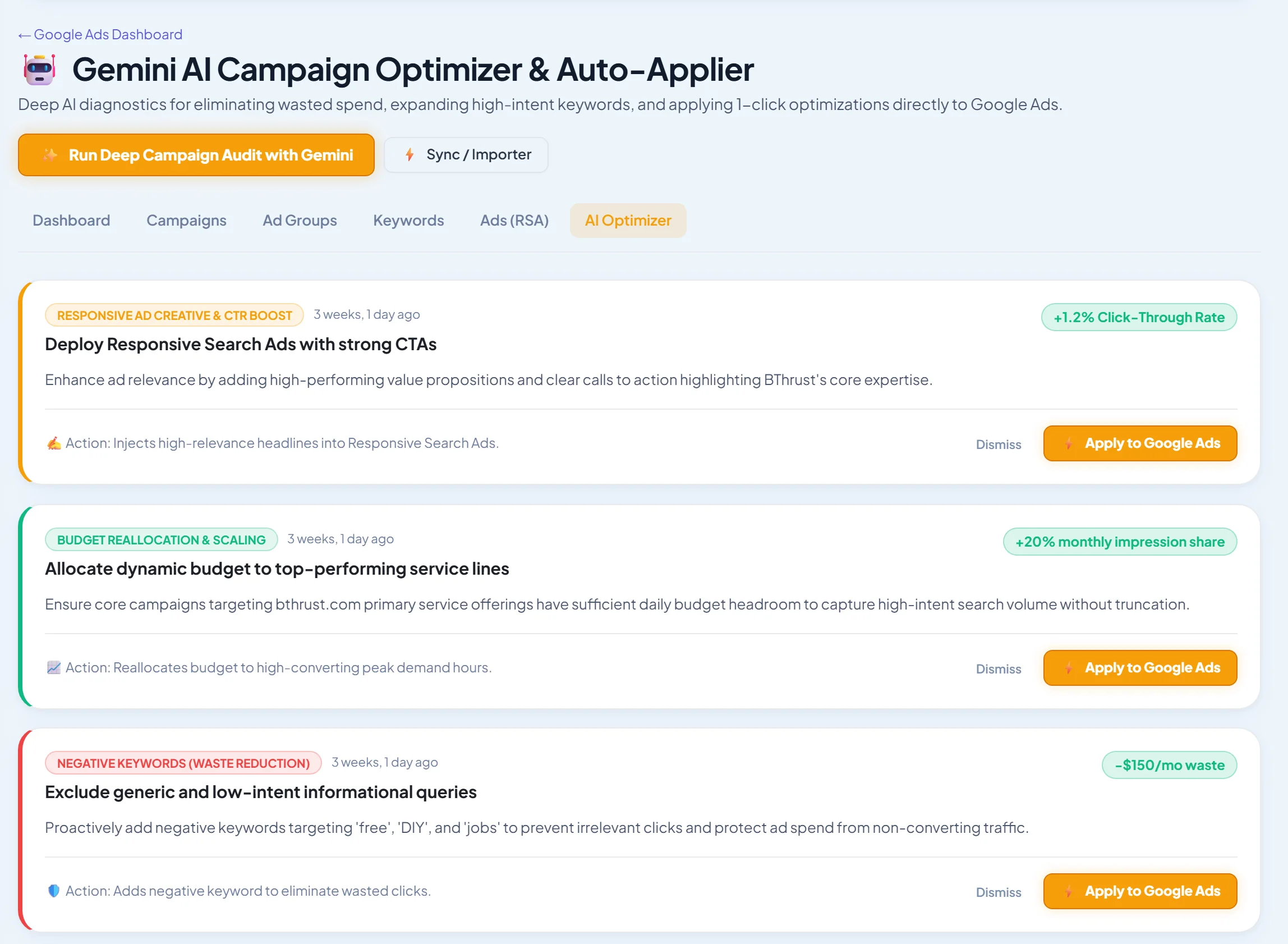
Key features: search-term mining for waste and negatives; Gemini audits with one-click apply; campaigns, keywords and budgets managed in-app and written back to Google Ads.
Pricing: Google Ads from $29/month; 14-day free trial. See plans.
Pros: plain-English suggestions; flat price.
Cons: less n-gram and cross-account depth than Optmyzr.
3. Adalysis: best all-round PPC analysis
Verdict: search-term and n-gram tools inside a broad PPC toolkit.
Pros: breadth.
Cons: an older interface.
4. Negator.io: best negative-keyword specialist
Verdict: built only for finding and adding negatives quickly.
Pros: focus; speed.
Cons: single-purpose.
5. Karooya: best for waste reports
Verdict: clear reports on where spend is wasted.
Pros: waste visibility.
Cons: narrower toolset.
6. Opteo: easiest recommendations
Verdict: negative keyword suggestions as part of its improvement queue.
Pros: ease.
Cons: less control.
7. Adzooma: best free plan
Verdict: basic negative suggestions free.
Pros: free.
Cons: lighter analysis.
8. WordStream: best guided workflow
Verdict: negatives as part of a weekly workflow for small advertisers.
Pros: guidance.
Cons: less depth.
9. Semrush: best for pre-launch negative research
Verdict: keyword research to build negative lists before launch.
Pros: research.
Cons: no account integration for negatives.
10. Google Ads search terms report: best free option
Verdict: the source data every tool uses, free inside Google Ads.
Pros: free; direct.
Cons: manual; Google hides some low-volume terms.
Starter negative keyword lists by industry
- All businesses: free, jobs, careers, salary, course, training, pdf, template, DIY (unless relevant).
- Local services: other cities you don't serve, "near me" variants outside your area, competitor brand names (in a separate list you review).
- Software: crack, torrent, open source (if paid only), login, download free.
- E-commerce: used, second hand, repair (if you only sell new), wholesale (if retail only).
- Professional services: definition, meaning, examples, salary, degree.
Review each list before applying it. "Free" is a bad negative for a business that offers a free consultation.
Match-type tips for negatives
- Negative broad blocks queries containing all the words, in any order. It's safe for single, clearly irrelevant words.
- Negative phrase blocks the words in that order, which suits multi-word ideas such as "how to".
- Negative exact blocks only that exact query, which suits routing traffic between campaigns.
- Negatives don't match close variants, so add plurals and misspellings yourself.
Related guides
Frequently asked questions
How often should I add negative keywords?
Weekly for active accounts, and daily for the first two weeks after launching a new campaign or switching to broad match.
What are common negative keywords?
Jobs, careers, free, cheap (for premium brands), DIY, how to, definition, and locations you don't serve. Tailor them to your business.
Can negative keywords hurt performance?
Yes, if they're too broad. A single-word broad negative can block good queries, so review lists and check search terms after adding them.
Should I use shared negative lists?
Yes, for terms that never fit any campaign. Use campaign-level negatives to control which campaign serves which query.
The bottom line
- PPC specialists: Optmyzr.
- Businesses and agencies running Ads beside SEO: SEO Runway.
- Negatives only: Negator.io.
- Small accounts: the free search terms report, weekly.
Start a 14-day free trial of SEO Runway and find wasted search terms in your account, or see the Google Ads workspace.