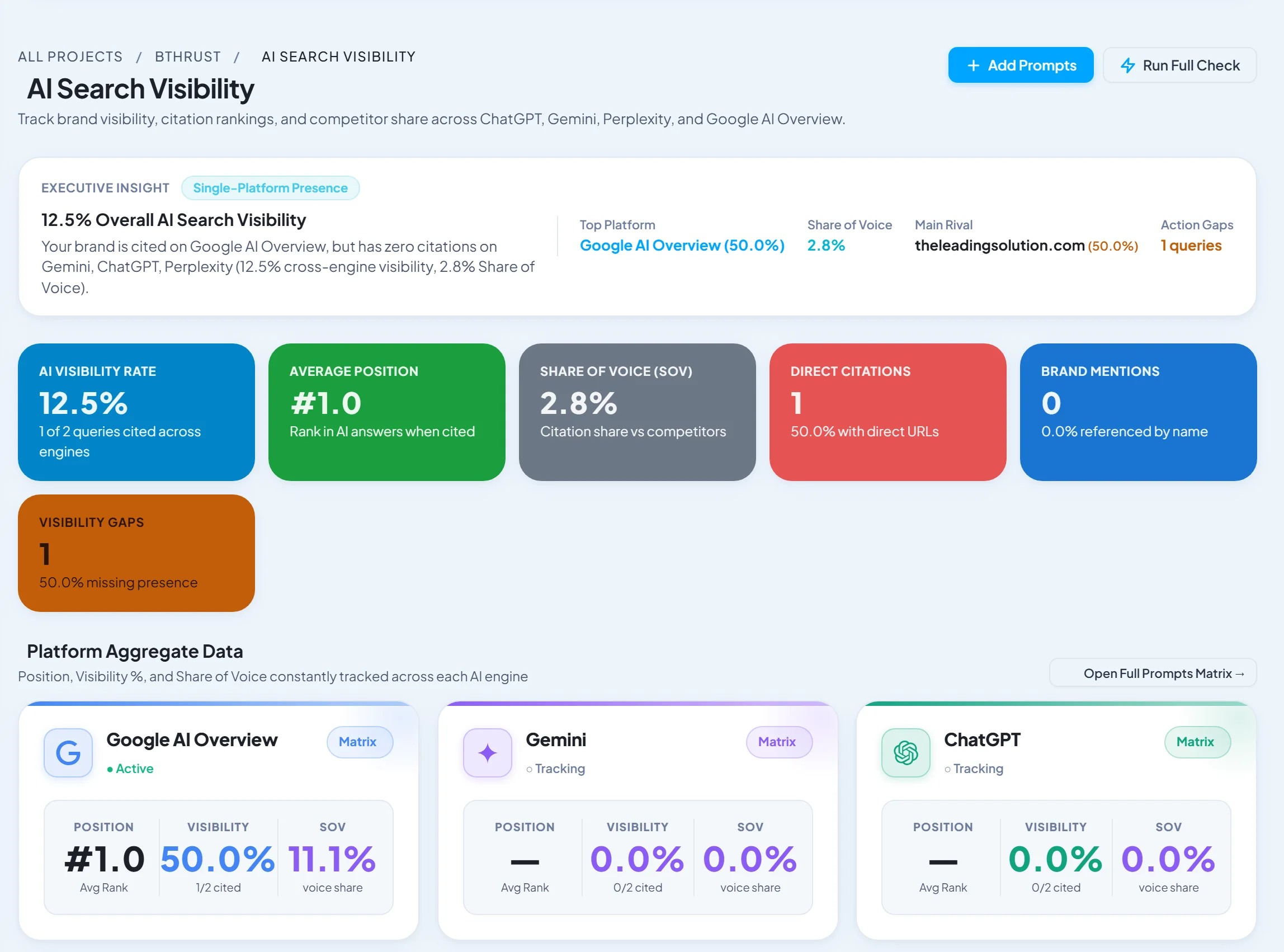

Short answer: for agencies managing several client sites, SEO Runway is the strongest all-round choice. Each client gets one project covering rank tracking, audits, keywords, content, AI visibility, local, Ads and social, plus white-label reports and a client login. Semrush and Ahrefs have the deepest research data, and SE Ranking offers the best value among the established suites.
Disclosure: SEO Runway is our product. We ranked it using the same criteria as every other tool, and noted where others do better.
An in-house SEO looks after one site. An agency looks after twenty, each with its own keywords, competitors, logins, deadlines and a client who wants to know what they are paying for. That changes what "best" means. Research depth still matters, but so do projects, seats, roles, reports and the cost per client. This guide compares ten platforms on the whole agency workflow.
Quick picks
- Best overall for agencies: SEO Runway
- Deepest research data: Semrush
- Best backlink data: Ahrefs
- Best value suite: SE Ranking
- Best budget option: Mangools or Ubersuggest
SEO software for agencies compared
| Tool | Multi-client projects | Seats | White-label reports | Client access | AI features | Local / AI coverage | From |
|---|---|---|---|---|---|---|---|
| SEO Runway | Yes, one project per client | Team roles | Included | Client role + share link | Audit plans, drafts, AI visibility | Geo-grid + 4 AI engines | $49 |
| Semrush | Yes | Per user | Add-on | Portal (add-on) | Writing, AI Toolkit | Local add-on, AI add-on | ~$139* |
| Ahrefs | Yes | Per user | Limited | No | AI helpers, Brand Radar | Limited local | ~$129* |
| SE Ranking | Yes | Add seats | Agency pack | Client seat | Content, AI tracker | Local add-on, AI add-on | ~$65* |
| Moz Pro | Yes | By plan | Partial | No | AI suggestions | Moz Local (separate) | ~$49* |
| Serpstat | Yes | By plan | Yes | Partial | AI content tools | Limited | ~$69* |
| Similarweb | Yes | By plan | No | No | AI insights | No | Sales-led* |
| Mangools | Limited | By plan | No | No | Light | No | ~$29* |
| SpyFu | Yes | By plan | Yes | No | Light | No | ~$39* |
| Ubersuggest | Limited | By plan | No | No | AI writer | No | ~$29* |
*Approximate entry price; verify.
How we chose these tools
We compared each platform's published features, plans and documentation against the six things that decide whether an SEO tool works for an agency:
- Multi-client projects: each client separate, with their own keywords, competitors and settings.
- White-label or client reporting: branded, scheduled reports.
- Team seats and roles: account managers, specialists and clients with the right access.
- Breadth: rank tracking, audit, keyword research, content and backlinks.
- Price per client at 10 and 50 clients, add-ons included.
- AI that does work: written audit plans, briefs and drafts, plus AI-answer visibility.
1. SEO Runway: best overall for agencies
Verdict: the only platform here that treats each client as one project across SEO, AI search, local, Ads and social, with the client layer (reports, client login, approvals, tasks) built in rather than bolted on.
Best for: agencies with 5–100 clients that sell more than one channel.
Key agency features:
- SEO: rank tracking by device and city/ZIP with share of voice and competitors; a site audit with a health score and a written Gemini action plan; keyword research; a Content Studio with SERP briefs, a live score and AI drafts; backlinks and outreach.
- AI search: prompt tracking across Google AI Overviews, ChatGPT, Gemini and Perplexity.
- Local: geo-grid map-pack scans, a citation audit and review monitoring.
- Client layer: white-label reports with your logo, a share link and scheduled delivery; a client role; tasks, a kanban board, workload, sign-offs and chat.
Pricing: Core SEO plans from $49 (Starter), $149 (Professional) and $399 (Agency); SEO + AI bundles from $129. Plans are modular, so you add only the workspaces you sell. 14-day free trial; annual billing saves about 20%. See all plans.
Pros: one project and one report per client; agency operations included; AI visibility built in.
Cons: a smaller backlink index than Ahrefs or Semrush; no log-file analysis for enterprise technical SEO; a newer brand.
2. Semrush: deepest research data
Verdict: the broadest research toolkit on the market, ideal for agencies whose value is competitive analysis.
Key features: keyword and competitor databases; Site Audit; Position Tracking; content marketing tools; the Agency Growth Kit for white-label reports and a client portal.
Pricing: from about $139/month per user; extra users, the Agency Growth Kit, local and the AI Toolkit cost more (verify).
Pros: data depth; a huge feature set; recognised by clients.
Cons: per-user pricing and add-ons make it costly for teams; the client layer is an extra purchase.
3. Ahrefs: best backlink data
Verdict: the best link index and a superb research workflow, but light on agency operations.
Key features: Site Explorer; Keywords Explorer; Site Audit; Rank Tracker; Content Explorer; Brand Radar.
Pricing: from about $129/month (verify); seats and usage limits vary by plan.
Pros: link data; usability.
Cons: limited white-label; no client portal; usage-based limits.
4. SE Ranking: best value suite
Verdict: a well-rounded, agency-friendly suite at a lower price than the big two.
Key features: rank tracking; audit; keyword research; content; a white-label agency pack; client seats.
Pricing: from about $65/month (verify).
Pros: value; good reports.
Cons: smaller databases than Semrush or Ahrefs; add-ons for white-label, local and AI.
5. Moz Pro: best for established workflows
Verdict: a trusted SEO toolkit with familiar authority metrics.
Key features: Keyword Explorer; Site Crawl; rank tracking; Link Explorer; Domain Authority.
Pricing: from about $49/month (verify).
Pros: DA is recognised by clients; solid fundamentals.
Cons: fewer agency features; local is a separate product.
6. Serpstat: best budget all-in-one suite
Verdict: a broad suite with white-label reports at a lower price.
Key features: keyword research; rank tracking; audit; backlinks; AI content tools.
Pricing: from about $69/month (verify).
Pros: breadth for the price.
Cons: smaller data in some markets.
7. Similarweb: best for market intelligence
Verdict: traffic and market data for agencies selling strategy to larger brands.
Pricing: sales-led for most agency use.
Pros: market-level insight.
Cons: not an SEO execution tool; expensive.
8. Mangools: best for small agencies on a budget
Verdict: simple, affordable keyword, SERP and rank tools.
Pricing: from about $29/month (verify).
Pros: easy; cheap.
Cons: no white-label reports or client access; limited audits.
9. SpyFu: best for competitor PPC and SEO research
Verdict: strong competitor history for SEO and Google Ads at a low price.
Pricing: from about $39/month (verify).
Pros: competitor data; white-label reports.
Cons: US-centric; limited audits.
10. Ubersuggest: best entry-level option
Verdict: affordable keyword and audit basics, with a lifetime plan option.
Pricing: from about $29/month (verify).
Pros: price; simplicity.
Cons: too light for agencies beyond a handful of clients.
Cost per client: a worked example
Entry prices mislead agencies. What matters is the monthly cost to serve all your clients with the seats and add-ons you need. Here is how to work it out, using an example agency with three team members that needs rank tracking, audits, white-label reports and client access:
- Base plan that covers your number of projects and tracked keywords.
- Plus seats: per-user pricing triples the base for a three-person team.
- Plus add-ons: white-label, client portal, local and AI visibility.
- Divide by clients at 10 and at 50.
| Setup | At 10 clients | At 50 clients |
|---|---|---|
| All-in-one with client layer included (e.g. SEO Runway Agency) | [calc] per client | [calc] per client |
| Research suite, 3 users, plus white-label add-on | [calc] per client | [calc] per client |
| Research suite plus separate reporting tool (per-client pricing) | [calc] per client | [calc] per client |
The pattern is usually the same: per-user and per-client pricing hurts as you grow, while plans with seats and reporting included get cheaper per client.
What agencies need that in-house teams don't
- Separation: client data, logins and reports that never mix.
- Client-facing output: branded reports and a client login that shows results without exposing internal work.
- Team operations: tasks, workload and approvals tied to each client.
- Several channels: most retainers now include local, paid or AI visibility, not only organic.
- Predictable cost as the client list grows.
How to migrate your agency's SEO stack
- Export rank history from your current tool for every client. Most allow CSV export.
- Set up tracking first in the new platform, and run both tools in parallel for one month.
- Re-run audits so baselines are fresh.
- Rebuild one report template, test it on two clients, then roll it out.
- Move clients over to the new share links or logins with a short note.
- Cancel the old tool after the next reporting cycle.
More guides in this series
- All-in-one SEO tools for small businesses
- SEO tools for freelancers and consultants
- Rank trackers for agencies
- Keyword research tools for agencies
- White-label SEO audit tools
- White-label SEO reporting tools
- All-in-one marketing platforms for agencies (SEO, Ads and social)
- AI SEO tools for agencies
Frequently asked questions
Which SEO tool do most agencies use?
Semrush and Ahrefs are the most widely used research tools, often paired with a separate reporting tool. More agencies are now moving to all-in-one platforms that include reporting and client access to cut costs.
Is Semrush or Ahrefs better for agencies?
Semrush has broader agency features (white-label reports and a client portal via add-ons) and more marketing tools. Ahrefs has the stronger backlink data and a cleaner research experience but fewer client-facing features.
Do I need separate reporting software?
Not if your SEO platform includes white-label reports, scheduled delivery and client access. You may still want a dashboard tool if you report many non-SEO channels.
How many seats does an agency need?
Usually one per person who does hands-on work. Favour platforms that include team seats or price by projects rather than by user as you grow.
Can clients log in to see their results?
With some platforms. SEO Runway has a client role that sees deliverables and reports only. Semrush offers a client portal as an add-on, and SE Ranking offers client seats.
The bottom line
- Agencies selling several channels that want one project and one report per client: SEO Runway.
- Research-heavy agencies: Semrush.
- Link-building agencies: Ahrefs.
- Value-focused agencies: SE Ranking or Serpstat.
- Small agencies starting out: Mangools or Ubersuggest, until you need a client layer.
Start a 14-day free trial of SEO Runway and set up your first three clients, or see the agency hub.